
Renovation & Property Refurbishment in North Cyprus
Full refurbishments of villas and apartments, bathroom and kitchen refits, suspended ceilings, flooring and stone cladding, across Kyrenia and the rest of North Cyprus. One firm running all the trades, an English-speaking team, a written quotation before anything starts and photographs at every stage if you are watching from the UK. Trading since 1999, with a 5-year workmanship guarantee.
Refurbishing a property you have bought here
Most of the refurbishment work we do falls into one of three situations. Somebody has bought a resale villa or apartment and wants it brought up to standard before they move in or let it. Somebody has owned a property here for fifteen years and the bathrooms, kitchen and finishes have reached the end of their life. Or somebody has discovered a problem — damp, a leak, blown plaster — and the repair has grown into a renovation.
All three have the same trap in them, and it catches buyers from Britain more than anyone, because the building stock here behaves differently from what they are used to. The visible work — kitchens, bathrooms, floors, paint — is the part that is easy to price and easy to imagine. The part that decides whether any of it lasts is underneath: whether the terrace above the bedroom has a working membrane, whether the bathroom floor was ever tanked, whether the external walls have any insulation in them at all.
Buildings put up before around 2005 very often have no meaningful waterproofing anywhere in them, and even where it was done, the bituminous materials of that period last roughly 15 to 20 years, so on a property of that age it has stopped working whether or not anyone has noticed. Newer builds have the opposite problem: waterproofing that exists but was installed too thin, with inadequate falls and rushed detailing, and starts to fail after two or three winters.
We survey before we price, and we will tell you what we find rather than what would be convenient to find. It is a more useful conversation to have before you commit a budget than after the tiles are down.
The order of works decides everything
This is the one thing worth understanding before you engage anybody for a renovation in North Cyprus, and it is the reason we keep waterproofing, facades and renovation under one roof rather than sending you to three firms.
- Plaster and paint over a damp wall will fail. If water is coming in from a terrace, a balcony or a foundation, the wall keeps getting wet from behind. The new plaster blows, the new paint blisters, and you have paid for the same room twice.
- A bathroom without tanking will leak into the room below. Not immediately — usually in the second or third year, once the grout has taken a few hundred thermal cycles. Fixing it means removing a bathroom you have just paid for.
- Render or insulation over a wet wall will come off. The bond is only as good as the surface behind it, and a surface that is drying from the inside pushes the system away from the wall.
- Screeds and plaster need their drying time. In dry Cypriot air materials can go off far too quickly and crack. A programme that does not allow for curing produces a floor that cracks in its first year.
So the sequence is fixed: waterproofing and damp first, structural and services second, plaster, render and insulation third, finishes last. Any contractor willing to start with the finishes because that is the quickest way to a nice-looking result is offering you a problem on a delay.
What we do
Bathrooms and shower rooms
A bathroom refit is the job where corners get cut most often, because the expensive part is invisible once it is finished. Tiles and grout are not waterproof — they are a wearing surface over the layer that is. Underneath ours there is a flexible cementitious tanking system, applied in two coats with reinforcing tape worked into every internal corner, around the threshold and around the drain, and the floor laid to a fall so water actually reaches the outlet. Skip that and the first sign of trouble is a stain on the ceiling of the room below, at which point the new bathroom has to come out again.
Kitchens
Strip-out, replumbing and rewiring where it is needed, plastering, tanking to the wet areas, tiling, flooring and fitting. We coordinate the trades rather than leaving you to chase an electrician who was supposed to come on Tuesday, and we handle the sequencing so the units go in after the floor and the plaster are properly dry rather than on top of a rushed programme.
Suspended ceilings and lighting
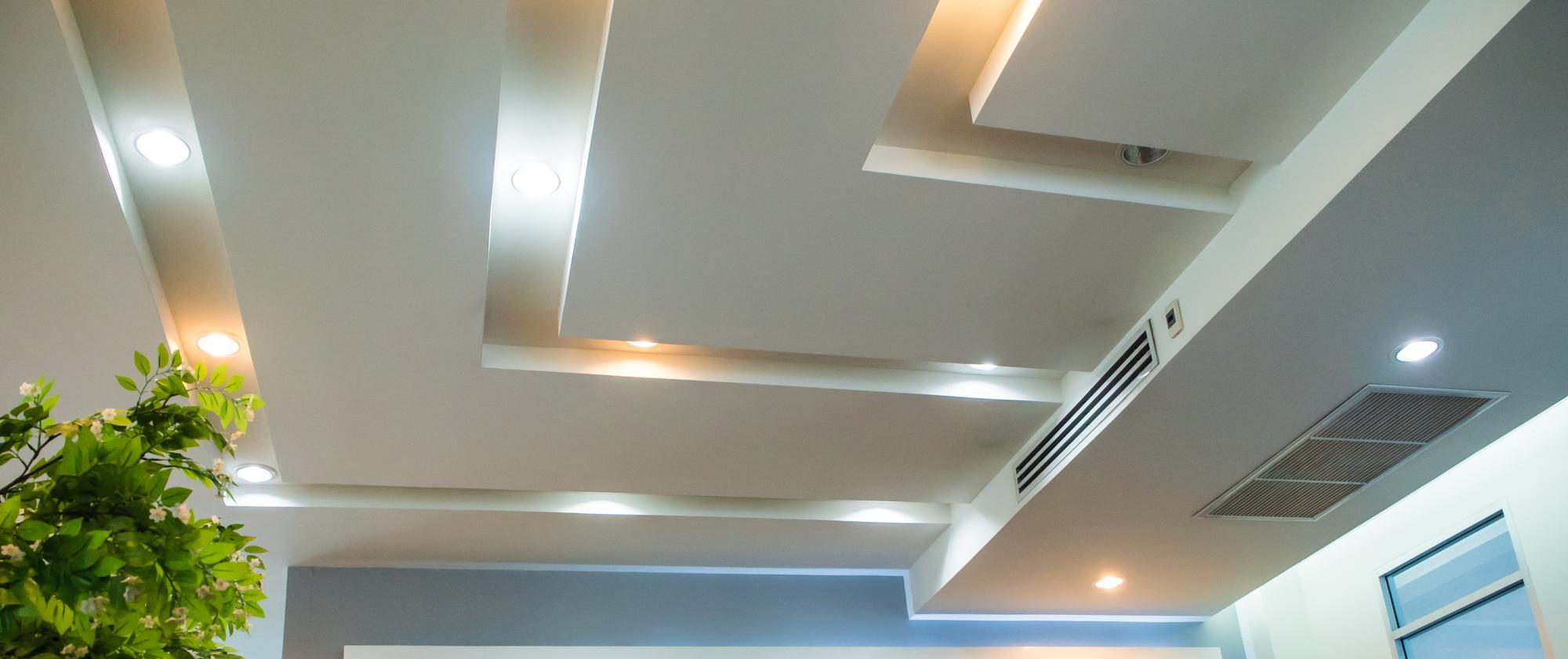
Plasterboard suspended ceilings are the most common and the most flexible, and they solve a specific Cyprus problem: they hide air conditioning pipework and ducting that would otherwise run across the wall. Stretch ceilings give a smooth, high-sheen surface, timber-look systems a warmer one, and metal systems suit commercial spaces. All of them let lighting be planned properly rather than worked around, and they help acoustically and thermally.
Flooring
Ceramic and porcelain tiles are the most durable option in this climate and the default in most properties here. Laminate is the economical choice, solid timber the luxurious one, vinyl the practical one, and self-levelling concrete gives a modern industrial finish. Heat and humidity matter to the decision — a floor that behaves in a British house does not necessarily behave in a Cyprus villa that stands empty and closed up for months.
Stone cladding and feature walls
Natural stone, reconstituted stone, brick-effect and three-dimensional wall panels, used on living room feature walls, kitchen splashbacks, around fireplaces, in stairwells and on garden walls. Natural stone is the choice outdoors, where it has to take weather; indoors either works.
Full property refurbishment
Strip-out and clearance, plumbing and electrical renewal, plastering and skimming, waterproofing to wet areas, interior painting, flooring, suspended ceilings, kitchen and bathroom fitting, and doors and windows. One firm running all of it, which removes the co-ordination problem that turns most self-managed renovations into a six-month project.
If you are not on the island while the work happens
A large share of our clients live in the UK for most of the year and own a property here that they use for part of it. Managing building work from two thousand miles away is the thing they worry about most, and with reason — the most common complaint owners have about building work in North Cyprus is not the standard of the work but not being told what is going on.
How we handle it:
- We survey the property and send you the assessment in writing, in English, with photographs of anything we are concerned about.
- The scope and the quotation are agreed by email or phone before anything is booked, so you are not approving costs under pressure.
- You get photographs at each stage — strip-out, first fix, tanking, plaster, finishes — rather than a single set at the end.
- If we find something unexpected once the strip-out starts, you hear about it with a photograph and a cost before we proceed, not on the final invoice.
- If the dates move because of weather or materials, you hear that from us first.
You can see the standard of finish on our completed projects page, which includes residential developments and hotels around Kyrenia as well as private villas and apartments.
How we work
One firm, all the trades
Waterproofing, plastering, tiling, ceilings, flooring and decorating under one contract. No co-ordinating four subcontractors from another country.
We work for absent owners
Scope agreed remotely, photographs at every stage, and a property that is finished when you land rather than a building site you have to supervise.
The right order of works
Waterproofing before finishes, always. A refurbishment laid over an unresolved damp problem is a refurbishment you pay for twice.
What happens, step by step
Free survey and honest assessment
We walk the property with you, or on your behalf if you are not on the island, and tell you what we find — including the things you did not ask about. If there is water coming in from a terrace or a balcony, that has to be dealt with before anything cosmetic happens, and it is better to hear it before you have committed a budget than afterwards.
Scope, specification and written quotation
A written quotation setting out what is included, the materials and systems being used, the price and the expected duration. Where you want to make choices — tiles, sanitaryware, flooring, ceiling type — we set those out so you can price the options rather than discovering them mid-job.
Strip-out and first fix
Demolition, clearance, then plumbing and electrical first fix. This is the stage where hidden problems surface — old pipework, failed waterproofing, damp in a wall that nobody could see. We photograph anything unexpected and come back to you with the cost implication before proceeding, not after.
Waterproofing, plaster and screeds
Tanking to wet areas, plastering and skimming, floor screeds. Everything here has to be given proper drying time. In dry Cypriot air a screed can go off far too fast and crack, so it is kept damp while it cures — rushing this stage is why floors and plaster crack a year later.
Second fix and finishes
Tiling, flooring, suspended ceilings and lighting, kitchen and bathroom fitting, doors, then decorating. The order is fixed for a reason and we keep to it, because working out of sequence is how finished surfaces get damaged and re-done.
Snagging and handover
We walk the property, list what needs correcting and correct it before we call the job finished. If you are abroad, you get photographs at each stage throughout and a full set at handover. The workmanship carries a 5-year guarantee.
Renovation & Refurbishment: Frequently Asked Questions
What property owners in Kyrenia and across North Cyprus ask us most
Talk to us about your property
Whether it is one bathroom or a whole villa, the first step is the same: we come and look, tell you what we find, and put a written quotation in front of you. No charge for the survey, and no obligation. Kyrenia, Nicosia, Famagusta, İskele and Güzelyurt.