
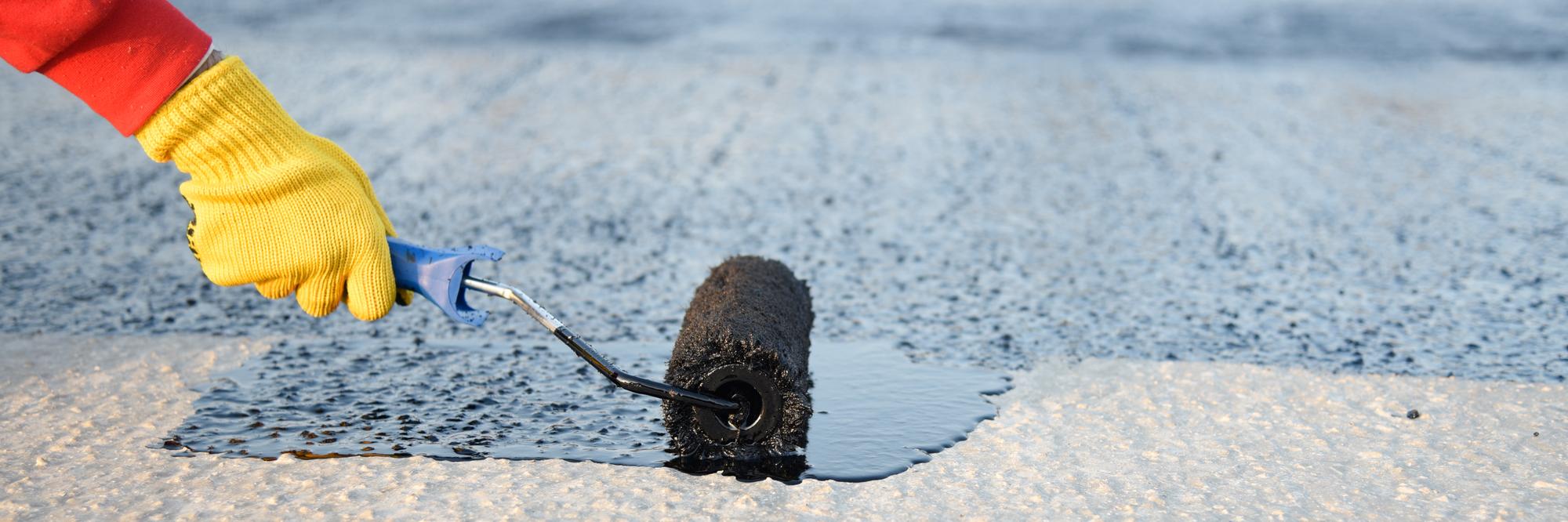
Waterproofing & Damp Proofing in North Cyprus
Leaking flat roofs, damp walls, balconies soaking the flat below, basements that smell of earth every winter and pools quietly losing water. We have been dealing with all of it from Alsancak, just outside Kyrenia, since 1999. Every job starts with a free survey to find where the water is actually getting in, and finishes with a written 5-year workmanship guarantee.
Why buildings leak here
Most people who buy property in North Cyprus arrive with the idea that it is a dry island and that water is somebody else's problem. The rainfall figures support that: around 500 mm a year, less than most of Britain. What the figures do not show is that roughly 60 per cent of it falls between December and February, in short and heavy bursts.
So the year splits into two halves that work against each other. From April to October, intense UV and heat do the damage. The UV index in Kyrenia reaches 11 in July, two to three times what central Europe sees, and it is still at 9 in April and May. A dark flat roof reaches a surface temperature of 70 to 80°C on a summer afternoon and falls back to 20 to 25°C overnight. That daily swing of 50 to 60 degrees is repeated hundreds of times a year. Bitumen hardens, loses its flexibility and opens micro-cracks — at the seams, at the parapet upstands and around every pipe that comes through the roof.
Then in December the rain arrives all at once and finds every one of them. That is the pattern behind the great majority of leaks we are called out to, and it is why waterproofing that would be perfectly adequate in northern Europe fails early here.
On the coast there are two more factors. Airborne salt accelerates corrosion of metal outlets, edge trims and the reinforcement in the concrete, and it is measurable up to a kilometre inland. And winter humidity along the Kyrenia and Famagusta coastline sits at 75 to 80 per cent, which is high enough to cause condensation and mould inside a property with no leak at all — something a lot of British owners meet for the first time in their second winter here.
Four kinds of damp, and why telling them apart matters
Damp is not one problem with one fix. There are four distinct causes, they produce different marks on the wall, and treating the wrong one is how people end up paying twice. This is the first thing we work out at the survey.
Rising damp
Ground water drawn up through the wall by capillary action. The risk depends on where you are: along the Kyrenia coast the water table sits only one to three metres down, so there is water within reach of the foundations for much of the winter.
What you see: A wet band starting at floor level and reaching anywhere from 50 to 150 cm up the wall. White salt deposits on the plaster. Paint blistering off. A soil and cellar smell in ground-floor rooms.
How to tell: It does not follow the weather. If the wall is still damp in July after months without rain, it is almost certainly rising damp.
Penetrating damp
Rainwater entering through a crack, a failed joint or a section of missing waterproofing — the roof, terrace, balcony, an external wall or a window surround.
What you see: Isolated patches rather than a continuous band. Ceiling staining below a terrace or balcony. Damp that spreads outwards from one point.
How to tell: It tracks the rain. If the patch appears or grows 24 to 48 hours after heavy rain and dries back in a dry spell, this is what you have.
Condensation
Warm, humid indoor air meeting a cold surface. In coastal Kyrenia, winter humidity sits at 75 to 80 per cent, and this is what catches British owners out.
What you see: Water running down window glass and frames. Black mould in external corners, behind wardrobes and on north-facing walls. Persistent damp on bathroom and kitchen ceilings. Worst first thing in the morning.
How to tell: It is worst in the coldest, most closed-up months, and it concentrates where the building is coldest — the thermal bridges. Uninsulated external walls make it dramatically worse.
Ground water under pressure
Water in saturated ground pressing against foundations and basement walls. From November to March the water table rises with the rainfall, and on the coast it does not have far to rise.
What you see: Standing water or wet floors in a basement or lower ground floor. A horizontal tide mark 50 to 100 cm up the wall. Seepage at the wall-to-floor junction. White efflorescence.
How to tell: This is the most damaging kind and the most expensive to leave alone — the water reaches the reinforcement in the concrete and starts corroding it.
Condensation and mould are frequently made much worse by uninsulated external walls, because the wall surface stays cold enough for moisture in the air to settle on it. Where that is the cause, the durable answer is on our external wall insulation and rendering page rather than this one. We will say so at the survey.
Why so many new-build properties leak after two or three winters
A leaking twenty-year-old roof surprises nobody. A leaking three-year-old villa surprises everybody, and it is one of the most frequent calls we take. The reasons are consistent enough that we can usually predict what we will find before we get on the roof.
- A single membrane layer. One layer is quicker and cheaper. In this climate the standard is two — 3 mm then 4 mm — with the joints staggered so they never line up. A single layer has no redundancy: one failed seam is a leak.
- Falls that are too shallow or missing. The minimum is 1.5 to 2 per cent towards the outlets. Get it wrong and water stands on the roof after every downpour, loading the membrane with constant hydrostatic pressure. Water still sitting there 48 hours after the rain stopped is not normal and will not dry its way out of being a problem.
- Rushed detailing. Membrane that stops short of the required 20 cm upstand at parapets, overlaps under the 10 cm minimum, seams welded unevenly, no reinforcement around outlets and pipe penetrations. Nothing here is visible from the ground on handover day.
- Membrane left bare in the sun. Exposed bitumen with no mineral facing, screed or gravel over it ages fast under a UV index of 11 and cracks years early.
- Later additions nobody sealed. Air conditioning units, satellite dishes, solar panels and water tanks bolted to a finished roof puncture the membrane. Left without a proper sealing detail, each fixing is a leak waiting for December.
None of this is fixed by finding the wet spot and patching it. Where the falls are wrong or the membrane was single-layer, the honest answer is to strip back and lay a correct system, and that is what our quotation will say.
What we waterproof
Flat roofs and roof terraces
The single most common call-out we get, and the one that does the most damage while it is ignored. A flat roof in Cyprus takes the full load of the climate: surface temperatures of 70 to 80°C on a dark roof in summer, dropping to 20 to 25°C overnight. That 50 to 60 degree daily swing is repeated hundreds of times a year, and it works micro-cracks into the membrane, the parapet upstands and every pipe penetration.
Two things decide whether a flat roof survives here: the falls and the detailing. A flat roof needs a minimum fall of 1.5 to 2 per cent towards the outlets. A great many roofs in North Cyprus were either never laid to a fall or have settled flat over the years. If water is still standing 48 hours after the rain stops, you have a falls problem, and no membrane on the market will survive permanent standing water on top of it.
Where the falls are wrong we lay a new screed, at least C20/25 and a minimum of 3 cm thick, before any membrane goes down. Correcting the falls is not an optional extra — it is the difference between a repair and a repeat.
Balconies and terraces over living space
A balcony leak rarely announces itself on the balcony. It announces itself on the ceiling of the apartment underneath, which is why balcony leaks so often turn into a dispute with a neighbour. Around 80 per cent of balcony repairs trace back to a failure in the waterproofing layer rather than anything structural.
The usual sequence is the same each time: the balcony has too little fall, water sits on it for two or three days after each downpour, and it finds its way through grout lines and hairline cracks into the slab. Once it is in the slab it corrodes the reinforcement, and that is a far bigger job than the one you started with.
A permanent balcony repair means lifting the existing tiling, re-laying the screed to a proper fall, applying a flexible two-part cementitious waterproofing layer in two coats, dressing the upstands and the threshold with reinforcing tape, fitting a proper outlet collar, then protecting it with a screed before it is re-tiled. Cover-up products applied over the existing tiles buy you a season or two, no more.
Foundations, basements and retaining walls
Ground conditions here vary more than people expect, and they decide how much risk a building carries. The coastal strip is largely sandy and rocky, and along the Kyrenia coast the water table sits just one to three metres below the surface — the highest-risk ground on the island, and exactly where most foreign-owned property is. Inland from Kyrenia it is rocky and calcareous with the water table three to six metres down. Nicosia, on clay and limestone at six to ten metres, is comparatively forgiving. From November to March the level rises with the rain.
In a building where the foundation was never properly tanked, that water works through the pores in the concrete. It often takes five to ten years to show, and then it shows as mould, salt staining and structural damage in the lower ground floor.
On the positive side — the face the water arrives from — we use bituminous membrane or a two-part liquid-applied bituminous coating, protected before backfilling. Where the water can only be dealt with from inside, which is the case in most existing basements, the answer is a cementitious tanking system. Bitumen applied to the inside face of a basement wall will blister and peel off under water pressure; it belongs on the outside.
Bathrooms, shower rooms and kitchens
Tiles and grout are not waterproof. They are a wearing surface over the layer that is. In a wet room the tanking sits underneath the tiling and turns the floor and the lower part of the walls into a sealed tray, with reinforcing tape worked into every internal corner and around the drain.
This is the part of a bathroom refit that is easiest to skip and most expensive to put right, because putting it right means taking the finished bathroom out again. If you are having a bathroom renovated, make sure the quotation says what the tanking system is. Ours does.
Swimming pools and water features
A pool has to be waterproofed in two directions at once: water pushing out from the inside, and ground water pushing in from the outside. It also has to survive chlorinated water, UV, and summer air temperatures of 38 to 42°C in Kyrenia against 22 to 25°C at night.
On the inside face we use a crystalline cementitious system, brushed on in two crossed coats to a total thickness of 2 to 3 mm and then kept damp for three to five days to cure properly. Crystalline systems grow into the pore structure of the concrete rather than sitting on top of it, which is why they hold against pressure from the wrong side. Outside, below ground, we use two layers of torch-applied membrane protected with XPS board before backfilling.
Most pools we are called to are not leaking through the shell. They are leaking at the skimmer box, the light fittings and the pipe penetrations, because those details were never sealed properly. We finish every pool with a water test: three days at half fill, then seven days at full fill, with a maximum accepted loss of 0.5 cm a day once evaporation is accounted for. No tiling goes on a pool that has not passed that test.
Pool and foundation waterproofing on hotel and residential developments makes up a good share of our work as well — Merit Park Hotel, Merit Royal Premium, Emtan West Park and Emtan Quattro among them. You can see the detail on our completed projects page.
The systems we use, and where each one belongs
There is no single best waterproofing material. There is a right material for a given surface, a given direction of water pressure and a given climate. Most of the failures we are asked to put right are not poor-quality products — they are the wrong product in the wrong place.
Torch-applied bituminous membrane
Polymer-modified bitumen sheet, heated with a gas torch and bonded to the substrate. This is the workhorse for large horizontal areas — roofs, terraces and the positive face of foundations. In this climate we apply two layers, 3 mm then 4 mm, with a minimum 10 cm overlap at every seam and the second layer offset by at least 50 cm so the joints never line up. At parapets the membrane is carried at least 20 cm up the wall. Bare membrane is never left exposed to Cypriot sun: it is either mineral-faced or covered with screed or gravel, otherwise UV ages it out years early.
Flexible cementitious waterproofing
A two-part brush or trowel-applied system that bonds chemically into the pores of concrete, screed and render rather than sticking to the surface. It is applied in two coats, roughly 2.5 to 3 kg per square metre in total, with reinforcing tape in the corners and a third pass at junctions. It stays vapour-open, so it will not trap moisture and blister on a wall that is drying from behind, and tiles can be bonded directly over it. This is what belongs in bathrooms, on balconies and on internal basement faces.
Crystalline systems
Cementitious coatings that react with moisture in the concrete and grow crystals into its capillaries, sealing it from within. They resist chlorides and continuous water pressure, including pressure from the negative side, which makes them the first choice on the inside face of pools, water tanks and basements. They need a saturated, matt-damp substrate to work — applied to dry concrete, or rushed in 35°C midday heat, the crystal formation is compromised.
Two-part liquid-applied bitumen
A cold-applied thick coating, so no flame and no torch. It cures to a seamless, flexible layer typically 2 to 4 mm thick when dry, and it takes the shape of awkward details — internal corners, pipe roots, anchor points — far better than a sheet can. Applied in at least two coats; where there is water table pressure the first coat carries a reinforcing mesh.
The rule of thumb we work to: bitumen on the positive face — the side the water arrives from — where a thick, tough, flexible barrier is needed over a large area. Cementitious systems where the surface has to stay vapour-open, where tiles are going on top, or where the water has to be held back from the inside. Get that the wrong way round and the system blisters off within a couple of years, whatever it cost.
How we work
We find the cause, not just the symptom
Water travels. The wet patch is rarely above the hole. We survey before we price, and we will tell you if the real problem is something other than the one you called about.
Systems matched to the surface
Bitumen on the positive face, cementitious on the negative face, crystalline in pools and tanks. Using the wrong one in the right place is the most common reason waterproofing fails here.
25+ years of it, in this climate
Trading from Alsancak since 1999, on villas, apartment blocks and hotels. Every installation carries a 5-year workmanship guarantee alongside the manufacturer's material warranty.
What happens, step by step
Free survey and diagnosis
We come and look at the property before we quote anything. The point is to find where the water is actually coming from, which is often not where it appears. A ceiling stain in a bedroom can be a roof outlet, a cracked parapet, a balcony above or a condensation problem, and the four have completely different fixes. If it is condensation and not a leak, we will tell you that rather than sell you a membrane.
Written quotation
You receive a written quotation setting out the scope, the system we intend to use, the price and the expected duration. If you are in the UK we send it by email and go through it with you before anything is booked. Nothing starts on a verbal figure.
Strip back and surface preparation
Old tiling, failed membrane and loose screed come off. Cracks deeper than about 5 mm are cut out, filled with repair mortar and left 24 hours to cure. The substrate has to be genuinely dry before bituminous work starts — after rain that means waiting at least 48 hours, checked with a moisture meter rather than by eye.
Falls and screed
Where water has been standing, a new screed is laid to a minimum fall of 1.5 to 2 per cent towards the outlets, at least C20/25 and a minimum of 3 cm thick. In dry Cypriot air a screed can go off far too quickly and crack, so it is kept damp while it cures.
Waterproofing and detailing
Primer first, then the waterproofing system itself. On a membrane roof that means two layers with 10 cm overlaps and staggered joints, upstands taken 20 cm up parapet walls, and reinforcement at every outlet, pipe penetration and internal corner. The details are where systems fail, so this is the slow part of the job and we do not rush it.
Testing, protection and handover
Seams are checked, and where the design allows we flood-test the area for 24 to 48 hours before covering anything up. Pools get a full seven-day water test. Only then does the protective screed, gravel or tiling go on. You get photographs of each stage, which matters if you were not on the island while the work happened, and a 5-year workmanship guarantee.
Waterproofing & Damp Proofing: Frequently Asked Questions
What property owners in Kyrenia and across North Cyprus ask us most
Book a free survey before the rains
Tell us what you are seeing — a stain on the ceiling, a balcony leaking into the flat below, mould that comes back every winter, a pool level that keeps dropping. We will come and look, work out where the water is coming from, and put a written quotation in front of you. Kyrenia, Nicosia, Famagusta, İskele and Güzelyurt.