What this covers, and what it does not
This is about the fabric of the building: the roof, the terraces, the balconies, the walls, the wet rooms and the pool. It is the part of the purchase nobody looks at properly, and it is the part that generates the largest unexpected bills in the first two or three years of ownership.
It is not about the legal side. Title, permits, contracts, payment schedules and everything connected with them are matters for a qualified independent lawyer, instructed by you and unconnected to the seller or the developer. Nothing here is a substitute for that.
We are a waterproofing and renovation contractor based in Alsancak, just outside Kyrenia, and we have been working on buildings across North Cyprus since 1999. A steady part of our work is being called in by people who have owned a property for eighteen months and hit their first serious winter. Most of what follows is the list of things we wish they had looked at first.
The summer viewing problem
Most buyers see the property between April and October. That is when flights are convenient, when the island is at its best, and when every building in North Cyprus is dry.
Around 60 per cent of the annual rainfall arrives between December and February, in short intense bursts. A roof with no falls, a cracked parapet detail or a balcony with a failed membrane will behave perfectly all summer and give you nothing to see. The defect is still there. It simply has no water to demonstrate itself with.
So on a summer viewing you are not looking for water. You are looking for the marks water leaves behind, and for the repairs someone has made to hide them.
Ask when it was last painted
Fresh paint on one wall or one ceiling in an otherwise tired room is worth a direct question. Damp patches painted over typically come back within three to six months, so a patch that has been redecorated recently and looks perfect in July may well have been redecorated because of what appeared in February. It is not proof of anything, but it tells you where to look harder.
New build and resale fail differently
Buyers tend to assume newer means safer. In this market that is not reliably true. The two categories carry different risks, and they need different questions.
Where the risk sits, by property type
| Newer build, under about 10 years | Resale, roughly 15 years and older | |
|---|---|---|
| Most likely cause of trouble | How it was detailed and built | Age. Materials have simply reached the end of their life |
| Typical roof issue | Single membrane layer, inadequate falls, rushed parapet and outlet details | Membrane at or past 15 to 20 years, hardened and cracking |
| Typical wall issue | Cold bridging at the concrete frame, condensation and mould in corners | Cracked render, blown paint, salt damage on the coastal strip |
| Ground floor | Usually adequate if the raft was tanked, but worth asking | Stock from the 1990s and earlier often had no tanking at all |
| What to ask for | Construction photographs and the specification actually used | Any record of works done, and when the roof was last touched |
| How it usually shows up | First or second winter after handover | Gradual, then all at once after a bad storm |
Two specific points. On newer developments the failure we see most often is a roof covered with one thin membrane layer and no properly formed falls, finished quickly at the end of the build. It gets through two or three winters and then lets go, which is exactly when the original developer has moved on.
On older stock, the issue is straightforward arithmetic. Buildings from the 1990s and earlier frequently had no waterproofing to current standards, and the bituminous materials used at the time have a working life of around 15 to 20 years. On anything built before about 2005, assume the original waterproofing is finished unless someone can show you otherwise.
What to look at on the viewing
You do not need equipment. You need twenty minutes and permission to walk around properly, including onto the roof.
Roof, terrace and balconies
- Get onto the roof. If the agent cannot arrange access, treat that as a finding in itself.
- Look for staining, silt lines or a tide mark on the surface, which show where water stands after rain.
- Check the outlets. Are there enough of them, are they clear, and does the surface fall towards them? You want a minimum fall of 1.5 to 2 per cent.
- Look at the membrane. Is it flexible and intact, or hard, cracked, blistered or hollow-sounding underfoot?
- Check where the membrane meets the parapet. It should be dressed at least 20 cm up the vertical face and terminated properly, not stopped at the corner.
- Look at every pipe, vent, air conditioning fixing and satellite bracket that penetrates the roof, and see whether it has been properly detailed or just bolted through.
- On balconies, check the threshold detail at the door, the drainage outlet, and the sealant at the wall junction.
- Look at the ceiling of the room directly underneath every balcony and terrace.
Inside the property
- Look along the top of external walls and into external corners, where condensation and mould show first.
- Look behind and under any furniture pushed against an external wall, which is where black spot mould starts.
- Check the ceilings under bathrooms, kitchens and any rooftop water tank for stains that are not weather related.
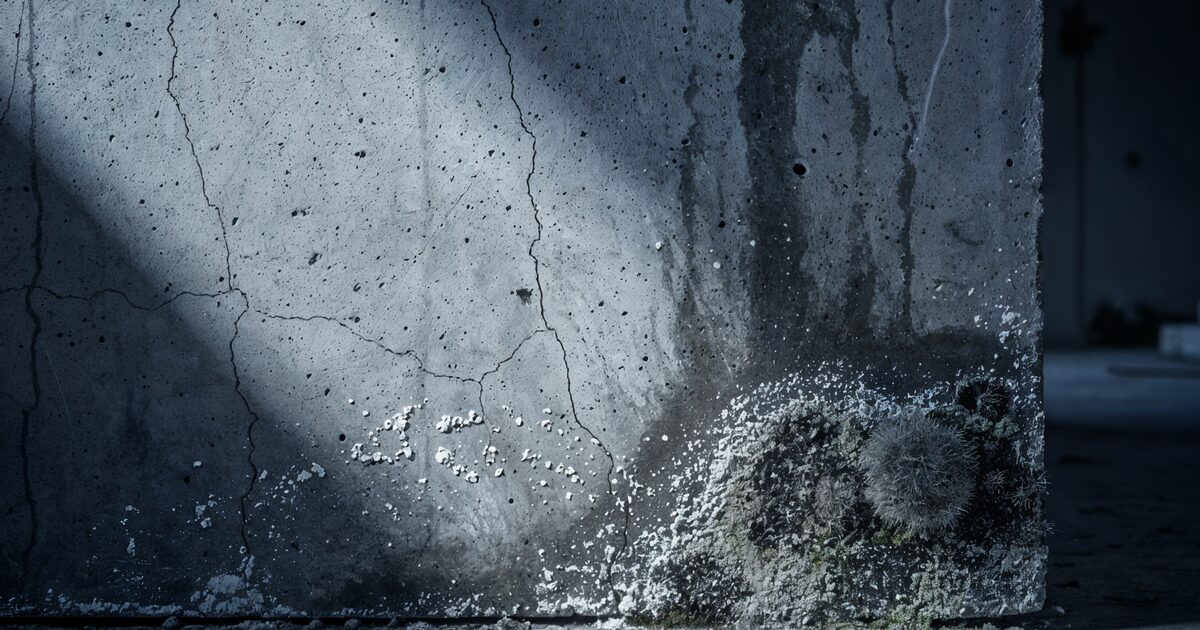
- On the ground floor, look for a horizontal tide mark 50 to 150 cm up the wall, white powdery salt deposits, or plaster that crumbles at low level.
- Open a window reveal and a wardrobe. Smell the room. A musty smell in a closed-up property is a real signal, not an atmosphere.
- Check under the sink, around the shower tray and behind the WC for the slow leaks that soak a floor slab for years.
- In an apartment, ask whether any neighbour has ever complained about water coming from this flat, or complained about water arriving in it.
Outside and the pool
- Walk the whole facade and look for cracking in the render, particularly around window and door openings.
- Look for paint that has blown or blistered, and for streaked, chalky areas where the coating has failed under UV.
- Check the base of external walls for damp staining and salt deposits after a wet spell.
- Look at how the ground is graded around the building. Ground that falls towards the wall sends water to the foundation.
- On a pool, look for cracked or hollow tiling, failed grout, movement joints that have opened and staining around the skimmer and lights.
- Ask whether the pool loses water, and how often it needs topping up. A precise answer is more reassuring than a vague one.
- Look at the ground and any retaining wall around the pool for permanently wet patches.
Questions to ask the developer or vendor
These are worth asking directly, in writing where possible. What you are testing is not just the answer but whether anyone knows it.
On the roof and terraces: what waterproofing system was used, how many layers and at what thickness? Were falls formed to the outlets, and at what percentage? Was the membrane dressed up the parapets, and how far? Was a water test carried out before the screed or tiles went down? Are there photographs from during construction?
On the ground floor and any basement: was the raft or foundation tanked, and from the outside or the inside? Was a drainage layer installed against the retaining walls? Does the property have a basement or semi-basement, and has water ever appeared in it?
On the wet rooms: were the bathrooms and the kitchen tanked underneath the tiling, or was the tiling laid straight onto screed? Tiles and grout are not a waterproofing layer, and a bathroom without tanking underneath will eventually show up in the room below.
On history and warranty: what waterproofing or roof work has been done since the building was completed, and by whom? Is any of it still under guarantee? Is the contractor who did it still trading?
On the building as a whole, for an apartment: who is responsible for the roof, and is there a maintenance fund? Under the condominium arrangements here, waterproofing of a balcony is generally the responsibility of the owner of that flat, and an owner whose balcony leaks into the property below can be liable for the damage. Ask whether any such dispute is running in the block.
A vague answer is an answer
"It is fully waterproofed" and "there has never been a problem" are not answers, they are reassurances. Anyone who built or maintained the property properly can tell you what system was used and show you something. The absence of any record is itself information, and it should feed into your offer.
What the findings actually mean
Finding something does not mean walking away. Almost all of it is fixable. What matters is knowing the size of the job before you agree a price, rather than discovering it in your first winter.
Common findings and what they usually lead to
| What you find | What it usually means | How urgent |
|---|---|---|
| Water standing on the roof 48 hours after rain | The falls are wrong. Re-screeding as well as re-covering | Before the next wet season |
| Membrane hard, cracked or blistered across the roof | Full re-cover rather than a patch | Before the next wet season |
| Ceiling stain under a balcony | Balcony to be stripped, re-graded, tanked and re-tiled | Soon. Water is already in the slab |
| Black mould in corners, streaming windows | Condensation. Insulation and ventilation, not a leak repair | Not urgent structurally, but it will not improve on its own |
| Salt band and crumbling plaster at low level | Ground moisture. Tanking, ideally from outside | Plan it in. It is slow but it does not stop |
| Cracked render, blown paint on the facade | Render repair and a UV-stable, water-repellent coating | Within a season or two, before water gets behind it |
| Pool losing more water than evaporation explains | Leak investigation, then shell or pipework repair | Before it undermines the surround or the building |
There is a straightforward negotiating point here. A roof that needs re-covering is a known, quantifiable amount of work. If you know that before you agree the price, it is a line in the negotiation. If you find out in January, it is simply a bill.
If you are buying off-plan
Buying off-plan gives you something a resale buyer does not have: the chance to see the waterproofing before it is buried. Once the tiles are down, nobody can tell you what is underneath without taking them up again.
The stages worth seeing on an off-plan purchase
Foundation and retaining walls, before backfilling
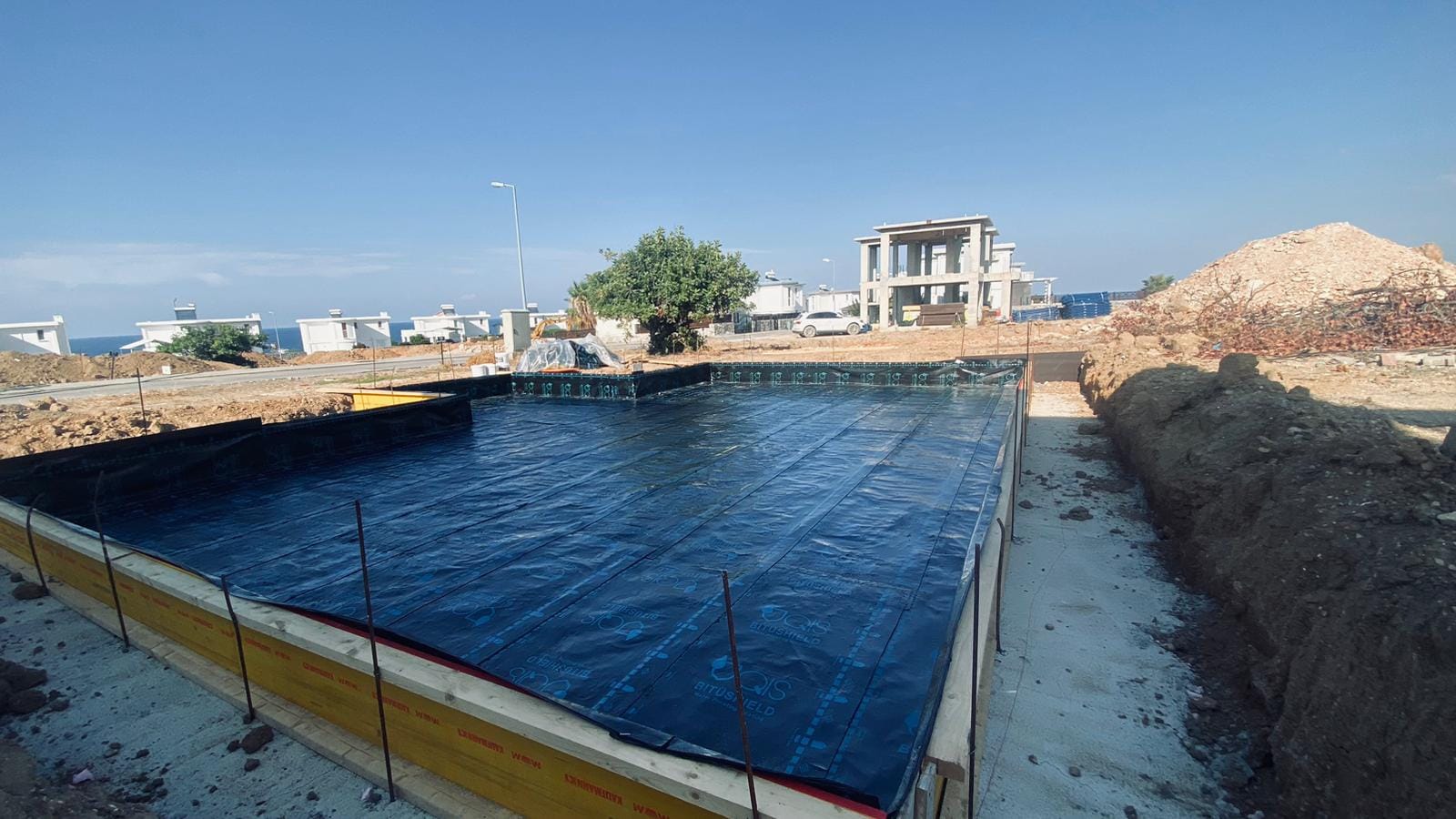
This is the only opportunity you will ever have to see whether the foundation and any retaining walls were tanked from the outside, and whether a drainage layer and protection board went in before the ground was pushed back. Ask for photographs on the day, not a description later.
Roof deck, before the covering goes on
Ask what falls have been formed and towards which outlets. A minimum of 1.5 to 2 per cent, running to outlets that are positioned at the low points, is what you want to hear. Falls are almost impossible to correct cheaply after the fact.
Roof membrane, before the finish
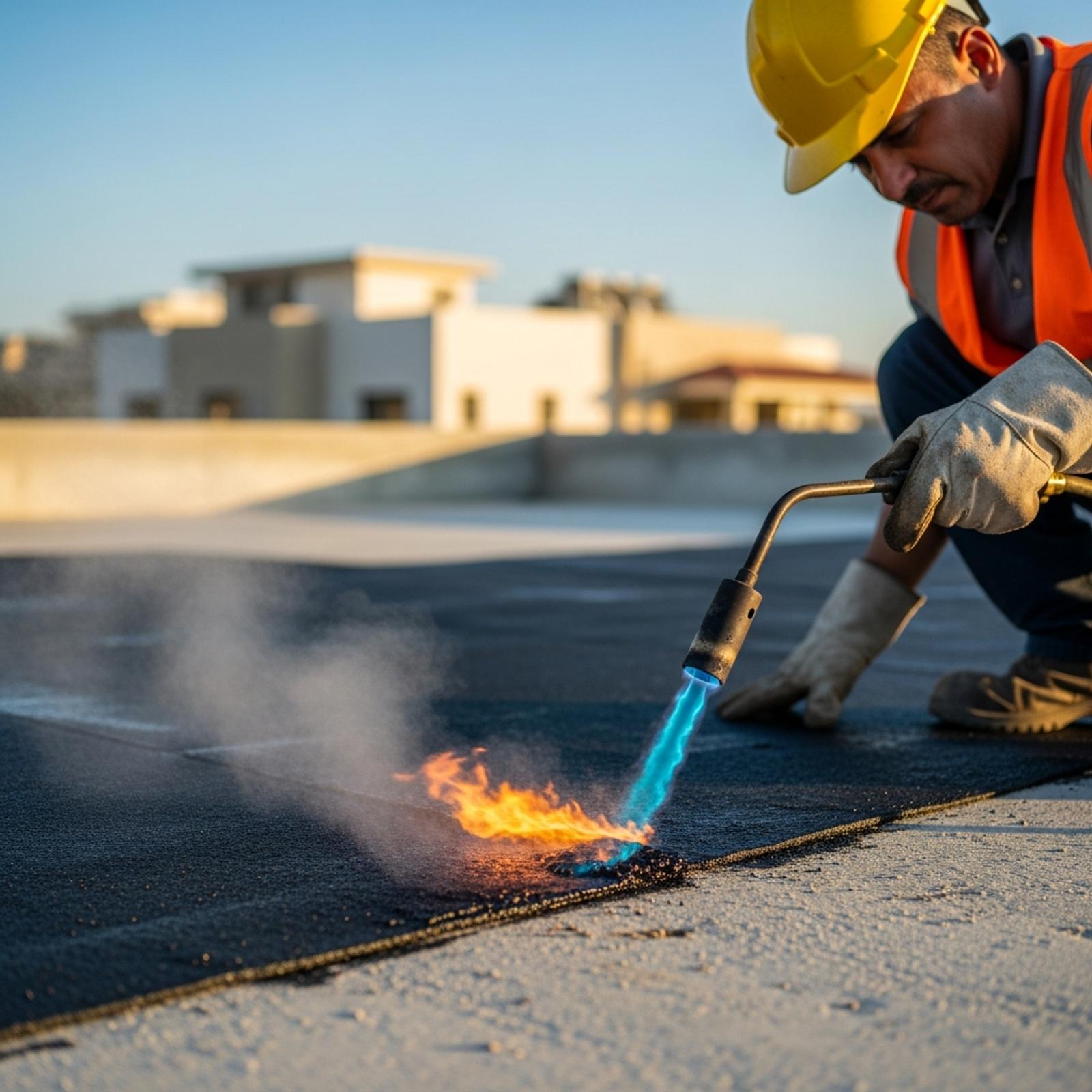
Photographs of the membrane laid, showing the overlaps, the upstands at the parapets and the detailing around outlets and pipe penetrations. Ask specifically how many layers and at what thickness. Ask whether a water test was done and for how long.
Wet rooms, before tiling
Bathrooms, shower rooms and kitchens should be tanked before the tiles go on, with the corners and the floor to wall junctions reinforced. Once tiled, this is invisible and expensive to correct.
Balconies and terraces, before tiling
Same principle: falls to the outlet, tanking, corner reinforcement at the wall junction and a proper collar at the drain. Balcony leaks into the flat below are one of the most common disputes in apartment blocks here, and they start at this stage.
Handover, in the wet season if you can
If your handover falls in the summer, arrange to have the property checked again after the first heavy rain. Snagging in August tells you about the plaster and the paint. Snagging in December tells you about the building.
Before you sign
The whole point of looking early is that everything on this list is cheaper to know about than to discover. A roof, a balcony, a basement or a pool can all be put right, and the work is not exotic. What ruins the first year of ownership is the surprise, not the repair.
Three things worth doing before you commit:
- Get onto the roof. If nothing else on this list happens, do that one.
- Ask the waterproofing questions in writing, and keep the answers.
- Have someone who works on buildings for a living walk round it with you, particularly on anything over about ten years old.
We survey free of charge before quoting, so you can have the waterproofing looked at before you commit. You get a written quotation for anything that needs putting right, which is a useful number to have in front of you during a negotiation. If you are still in the UK, we visit, photograph and send it through, which is how a good proportion of our work starts.
Twenty-five years of working on buildings here means we have seen how a great many of the developments around Kyrenia were actually built, which is a different thing from how they were specified.
More on what is involved in waterproofing and damp proofing, facades and rendering and renovation and refurbishment, or look through recent projects. If you want more detail on the specific defects mentioned here, our guides to damp and mould and flat roof leaks go further into each one.