The knock on the door
On a wet morning in January the neighbour downstairs knocks. There is water dripping from their ceiling, and they are certain it is coming from your balcony. Or you notice it from your own side first: damp patches under the tiles that never quite dry out, even through a dry week.
It is one of the most common winter problems on this island, and among British and other foreign owners it turns into something worse than a repair job. One of you is very likely to be off the island. There may be no on-site management, no factor, nobody with authority to make a decision. Messages go back and forth between the UK and Kyrenia, nobody wants to accept it is theirs, and meanwhile water keeps going into the slab every time it rains.
The useful part is that balcony leaks are well understood. Around 80 per cent of balcony repairs come down to a failure of the waterproofing system, and the failures repeat: five causes, a small number of construction details that decide everything, and one repair that actually works against several that only look like repairs.
Is it the balcony, or is it plumbing?
Answer this before anybody spends money, because a ceiling stain is evidence of water, not evidence of a balcony.
Reading the evidence before anything is opened up
| What you observe | Points to the balcony | Points to plumbing |
|---|---|---|
| Timing | Appears or grows within a day or two of rain, then dries back | Constant, or unrelated to the weather |
| Location on the ceiling | Under the balcony slab above, often near the wall junction or the door threshold | Under a bathroom, kitchen, water tank or a pipe run |
| Season | Winter, worst after the first heavy rains | Any time of year, often worse when the flat above is occupied |
| Water meter in the flat above | No movement with everything turned off | Creeps up with everything turned off |
| Above the stain | Standing water on the balcony after rain, cracked grout, damp threshold | No balcony above at all, or a dry one |
| What it means | Waterproofing repair at balcony level | Trace and repair the pipe, then make good |
Two checks anyone can do without a specialist. First, turn off every tap and appliance in the upstairs flat, read the water meter, then read it again a couple of hours later. Movement means a plumbing leak somewhere regardless of what the ceiling looks like. Second, go out onto the balcony after rain and look for standing water. If water is still lying there a couple of days later, the falls are wrong and you have found the most likely cause without any equipment at all.
One complication worth knowing. Water travels. It goes into the slab at one point, runs along the top of a beam and comes out somewhere else, which is why the wet patch on the ceiling below is often not underneath the actual defect. Chasing the stain upwards rarely lands on the right spot.
Why it damages the flat below first
The reason the neighbour notices before you do is that a balcony leak works downwards through the structure and the visible damage collects at the bottom.
Water leaving the balcony surface soaks into the concrete slab. Concrete is porous, so it takes the water up and passes it slowly down to the beams and columns beneath. At that stage the reinforcement inside starts to corrode and there is nothing at all to see. Rust occupies more volume than the steel it came from, so as it forms it cracks the concrete from the inside and begins to break it up. Only at the end of that sequence do the yellow-brown stains, damp and eventually falling plaster appear on the ceiling below.
That whole process from the first leak to the first ceiling stain can take 1 to 3 years. Which means two things. The neighbour complaining now is reporting something that started long before, and the concrete has had that whole period of moisture working on it. It also means that if you are the owner downstairs, a stain is not a decorating problem to be painted over next spring. It is the visible end of a structural process.
A ceiling stain is a late symptom
By the time water shows on the ceiling below, moisture has been in the slab for a long period and the reinforcement has had the same exposure. Redecorating the ceiling before the balcony above is dealt with is money spent twice, because it will come back with the next winter's rain. For the wider picture on long-term moisture in a building, see our guide to damp and mould in North Cyprus homes.
The five things that cause it
Nearly every balcony leak we open up comes down to these five, and usually to two or three of them at once.
1. Inadequate fall
The balcony floor needs a minimum fall of 1.5 to 2 per cent towards the outlet, which is 1:60 to 1:80. Once the gradient drops below 1:100, water stands on the balcony for 48 to 72 hours after rain and the leak risk multiplies, because standing water finds its way down through micro-cracks and grout lines under sustained pressure. This is the most common cause of all. On older buildings the fall was often never calculated, and on others it has flattened over time.
No membrane solves a falls problem. The right membrane over the wrong fall still leaves water standing on the balcony.
2. The door threshold detail
The junction between the balcony door threshold and the floor is the most critical water barrier on the whole balcony, and it is a small, fiddly detail that takes patience to get right. The mastic or joint filler used there hardens and cracks under UV, and once it has, rain runs under the threshold and straight into the room. Given the UV levels here, this point needs attention on average every 5 to 7 years.
3. The outlet
Where the balcony outlet meets the pipe, if the connection was left without a membrane collar or sleeve dressed into it, that is an open door for water. Add years of dirt and plant debris blocking the outlet itself, and the water that cannot drain has only one route left, which is down through the floor. This is the classic finding on a balcony nobody has maintained.
4. A worn membrane
Even a correctly installed balcony waterproofing system has a finite life. A balcony membrane is directly exposed to UV, and the expected life here is 10 to 15 years, against 15 to 20 years on a roof and 20 to 25 years below ground. Cracked by UV and fatigued by daily thermal cycling, it stops holding water. The damage is under the tiles and invisible from above, which is why balconies tend to be diagnosed by their symptoms downstairs rather than by inspection.
5. Neglected movement joints
The corner joints between the floor and the wall are deliberate gaps left for thermal movement. When the filler in them loses its flexibility, or the joint opens completely, you have a direct route in. These joints need a flexible mastic rather than a rigid filler, and renewing every 5 to 7 years.
Why this happens faster here
Solar radiation in North Cyprus is roughly 2 to 3 times the Central European level. A balcony floor in direct summer sun reaches a surface temperature of 60 to 70°C, putting the concrete, the tiles and the membrane underneath through tens of degrees of thermal cycling every single day. Every expansion and contraction cycle works slowly at the joints, the corner junctions and the membrane surface.
Then the winter arrives in short intense bursts rather than steady drizzle. Between November and March, 40 to 60 mm of rain can fall in a matter of hours, which on a balcony with insufficient fall becomes standing water very quickly.
A Kyrenia balcony is not a German balcony
Take two balconies built to the same standard with the same materials, one in Germany and one in Kyrenia. The German one may go 20 years without trouble while the Cypriot one needs attention in 10 to 12 years. The difference is the UV dose, the number of thermal cycles and the sea salt. On the coastal neighbourhoods around Kyrenia, salt air works into the pores of the balcony concrete, breaks down its crystal structure, widens the pores and raises its permeability, while accelerating corrosion of the reinforcement.
Check your own balcony
- Does water stand on the balcony after rain? (a falls problem)
- Is there damp or staining around the door threshold? (the threshold detail)
- Is the outlet dirty, blocked or left open with no collar?
- Any discolouration, blistering or loss in the tile grout?
- Any cracking in the mastic or render at the wall and floor corner?
- Has the neighbour below mentioned a mark on their ceiling?
Why coatings over the existing tiles fail
The offer is tempting, particularly if you are handling it remotely: nobody lifts anything, the balcony stays usable, and a liquid coating goes over the existing tiles. It is quick and it is cheap and it fails, for three reasons.
It bonds to the wrong thing. The coating adheres to the glazed tile surface rather than to the concrete, so it is only ever as well attached as the tiles are, and the tiles are already sitting on a failed system.
It leaves the problem in place. Whatever is wrong beneath the tiles, saturated screed, a split membrane, an unsleeved outlet, is sealed in rather than removed. Trapped moisture then works against the new coating from underneath.
It does not change the falls. If the water was standing before, it will stand on the new surface too, and standing water is what caused the failure in the first place.
Temporary repair against a permanent waterproofing system
| Temporary repair | Permanent system | |
|---|---|---|
| Cost | Low in the short term | Medium to high, economical over time |
| Life | 1 to 3 years | 10 to 15 years |
| Effectiveness | Partial, treats the symptom | Complete, resolves the source |
| Guarantee | None | Workmanship and materials covered |
| Risk to the flat below | Continues | Removed |
| Protects the structure | No | Yes, the reinforced concrete is protected |
| Repeat intervention | Every 1 to 3 years | Maintenance: joints renewed every 7 to 10 years |
The arithmetic is not subtle. An owner having a temporary repair done every three years will have paid for five interventions over fifteen years and exceeded the cost of the permanent system, while the risk to the flat below has continued the entire time and structural damage has accumulated underneath.
There is one sensible use for a temporary measure: buying a few months when the wet season has already started and the work cannot be done properly until spring. As a solution it is not one.
What a permanent repair actually involves
A permanent repair means taking the existing finish off and rebuilding the system from the concrete up. This is the sequence, and it is worth reading even if you are taking quotations elsewhere, because it gives you specific things to ask about.
Balcony waterproofing, step by step
Strip out and prepare the surface
The existing tiling comes off completely, along with the screed and old waterproofing layer beneath it. The concrete is examined for cracks, voids and damaged areas. Cracks deeper than 5 mm are filled with repair mortar and left to cure for 24 hours. The surface must be completely dry: after rain here that means waiting at least 48 hours, with the moisture level checked with a meter rather than judged by eye.
Falls screed
Where the existing fall is inadequate, a new screed is laid to give 1.5 to 2 per cent towards the outlet. This step is the one that decides whether the repair works, because without fall even the best membrane cannot stop water sitting. The screed should be at least C20/25 and a minimum of 3 cm thick. While it cures it is kept covered with damp cloth, because in the dry air here it can set too fast and crack.
Bituminous primer
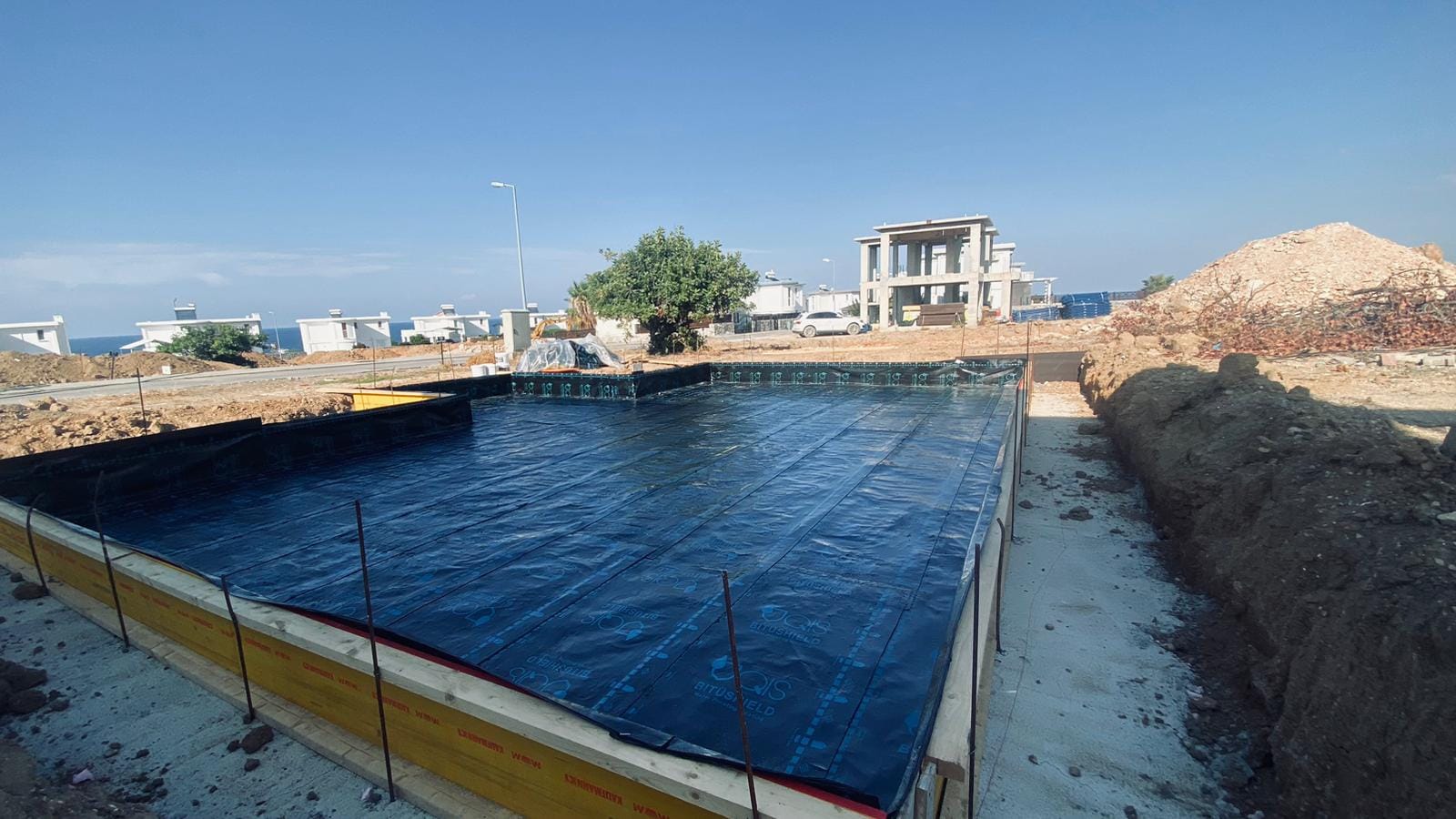
A bituminous primer is applied across the whole surface. It closes the pores of the concrete and gives the waterproofing layer something to bond to. Corners and the area around the outlet are worked especially carefully at this stage and given an extra brush-applied coat. Nothing goes on top until the primer has dried fully.
Cementitious waterproofing, two coats
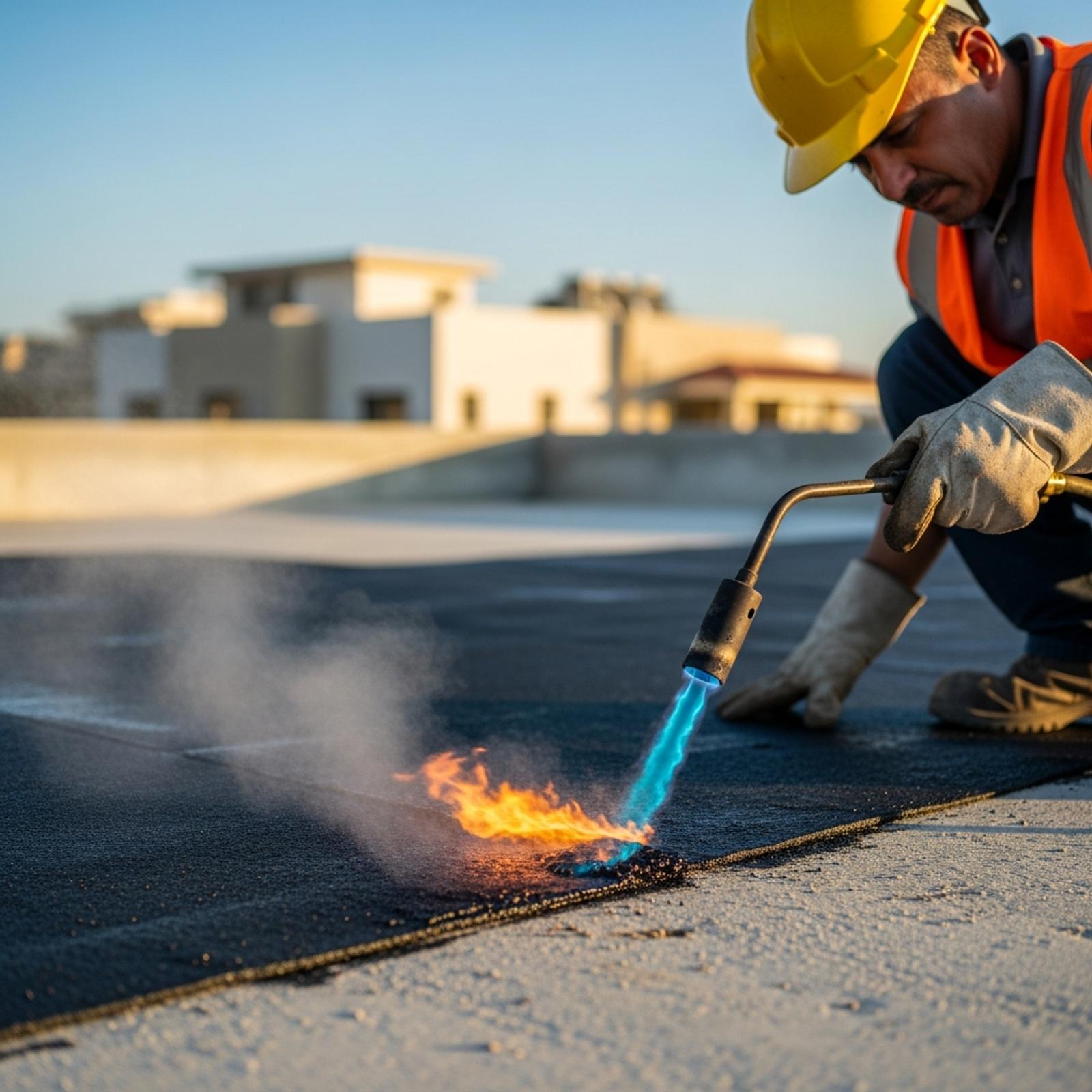
A flexible two-component cementitious waterproofing material is applied by trowel or roller in two coats, 2.5 to 3 kg/m² in total. The second coat does not go on until the first has dried completely. Elastic corner tape is embedded at the wall junctions and the door threshold, and those points get a third coat. The outlet is closed off with a proprietary drain collar. This layer is the heart of the system and it cannot be skipped or thinned down.
Protection screed
A C20/25 concrete protection screed of 3 to 4 cm goes over the waterproofing layer, shielding it from mechanical damage under the finish. Adding steel mesh or glass fibre reinforcement into this screed reduces the risk of cracking later on.
External tiling and jointing
Finally, non-slip frost-resistant external tiles are laid on flexible adhesive. Joints are filled with a waterproof, UV-resistant grout. The wall and floor corner joints are closed with elastic mastic rather than a rigid filler, and those need renewing every 5 to 7 years as ordinary maintenance.
Two points from that sequence are worth repeating because they are the two most often left out. The falls screed is not optional, and the drain collar at the outlet is not a detail. Everything else can be done perfectly and the balcony will still leak without them.
Repairing only the edge where the water appeared is usually not enough either. The leak may show at one point while the layer underneath has failed across a much wider area, which is why we normally recommend renewing the waterproofing across the whole balcony rather than patching a corner. More on the approach on our waterproofing services page, and you can see completed work in our recent projects.
Whose responsibility is it in a block?
This is where the dispute usually sits, and it is worth being careful about, because the answer is not the same in every building.
As a general principle, a balcony slab is part of the structure of the building rather than a private fitting like a kitchen cupboard. Leaks that pass from one flat into another are therefore usually treated as a shared or structural matter rather than as a purely private redecoration issue. But how the cost is actually apportioned depends on the individual building's own arrangements: what the title deeds say, what any management or maintenance agreement provides for, and what the block has agreed among the owners. Some buildings have a maintenance fund that covers exactly this. Many older blocks around Kyrenia have nothing of the sort.
Two pieces of practical advice. First, read the paperwork before the argument starts: the deed, any management agreement, and any block rules. Second, if a real sum of money is at stake, or the other party is refusing to engage, take local legal advice rather than relying on what anyone asserts at a residents' meeting. We are contractors, not lawyers, and we will not tell you what the law says.
What we can do is establish, in writing and with photographs, where the water is coming from and what it will take to stop it. In a disputed case that document is usually the thing that moves the conversation forward, because most disagreements between neighbours here are not really about liability. They are about the fact that nobody has established what is actually wrong.
Get the diagnosis in writing early
Where two owners disagree, an independent survey setting out the cause, with photographs, is worth more than months of messages. Both parties can then argue about a documented fact rather than about opinions, and in our experience the repair usually gets agreed once the cause is no longer in question.
Timing, and what to do if you are not on the island
The best periods for balcony waterproofing here are March to May and September to November, when temperatures sit at 15 to 28°C, the humidity is balanced and the risk of rain is low.
The two constraints are moisture and heat. Waterproofing should not be applied in rain or below 5°C, and the surface has to be genuinely dry, which after rain means waiting at least 48 hours. At the other end, in July and August the balcony surface can pass 60°C, at which point the membrane and screed materials dry far too fast and crack, so summer work is done early in the morning or on shaded elevations. The mild Cypriot winter means the work is technically possible at most times of year, but December to February is the season you want to be finished before, not the season to start in.
The practical implication is straightforward. If your neighbour complained last winter, the work wants booking for autumn, not for next January when it will be done in poor conditions on a slab that is never quite dry.
If you are an absent owner
- Get the diagnosis done now rather than waiting until you are next out. A survey needs access to the balcony, not to you.
- Ask for photographs of the cause, not just of the symptom. Standing water after rain, the threshold joint, the outlet.
- Ask whoever holds your keys to walk through and photograph ceilings after the first serious rain of the winter, in your flat and, if you can arrange it, in the one below.
- Get the scope in writing before agreeing anything, particularly if the cost is going to be split with another owner.
- Do not let a redecoration go ahead downstairs before the balcony above has been repaired. It will need doing twice.
We have been working on buildings in North Cyprus since 1999, more than 25 years, from Ankara Caddesi No:109 in Alsancak, just outside Kyrenia. We survey free of charge and tell you whether you are looking at a balcony problem or a plumbing one, you get the scope and the price in writing before anything starts, and the waterproofing carries a 5-year workmanship guarantee. Everything is handled in English, including while you are back in the UK.
Call +90 533 831 14 32 or email [email protected].
Related reading: flat roof leaking in North Cyprus if the water may be coming from a terrace rather than a balcony, damp and mould in North Cyprus homes for the wall side of the same problem, and our facade and rendering work if the elevation needs putting back afterwards.