The sunny island that still gives you damp
Most people who buy here do not expect damp. You have moved to an island with three hundred days of sunshine, you left the British weather behind, and mould in the corner of a bedroom feels like something that belongs to a flat in Manchester rather than a villa above Kyrenia.
It is one of the most common calls we get. Black mould behind a wardrobe on an external wall. A tide mark rising up the wall of a ground-floor apartment. A musty smell that hits you the moment you open the door after eight weeks away. Ceiling stains that appear in January and fade by April.
None of this means you have bought a bad property. It means the building is being asked to deal with conditions that are harder than they look, and in most cases it was not detailed to cope with them. The useful part is that damp is diagnosable. Only three mechanisms get water into a wall, each leaves a different signature, and each has a different fix. Almost every wasted pound we see spent on damp was spent treating the wrong one.
Why North Cyprus produces so much damp
The climate here is not gentle on buildings. It is two harsh climates in succession, and the transition between them is where damage happens.
The rain arrives all at once
Annual rainfall is around 500 mm, which is modest. The problem is that roughly 60 per cent of it falls between December and February. That is not steady drizzle. It is intense rain arriving in short bursts, on a building that has spent the previous six months being baked. Every hairline crack that opened up over the summer gets tested at once, under real water pressure.
Coastal humidity is higher than people expect
On the Kyrenia coast, humidity through the winter months reaches 75 to 80 per cent. That is the moisture load your walls and windows are working against. Add cooking, showering and drying laundry indoors in a closed-up property, and the indoor air holds far more water than the surfaces can cope with.
Sea salt gets into everything
Salt carried in off the sea works into the pores of concrete and render. It accelerates corrosion of the reinforcement, breaks down the surface of the masonry and increases how readily it takes up water. The effect is strongest on the coast but is still measurable 500 to 1,000 metres inland, so on the strip through Kyrenia, Alsancak and Çatalköy it is a permanent background pressure on the fabric.
Flat roofs and terraces
Almost every building here has a flat roof or a roof terrace. A pitched roof sheds water whether or not anyone thought about it. A flat roof only works if the falls are right and the membrane is properly detailed, and if either is wrong the water sits there until it finds a way in. A very large share of the damp we are called to look at is a roof or terrace problem showing up on a wall or ceiling one or two storeys below.
Thermal movement opens the paths
Summer air temperatures run at 33 to 37°C, and a dark flat roof surface in direct sun reaches 70 to 80°C before falling back to 20 to 25°C overnight. That daily swing of 50 to 60 degrees makes concrete, render and membrane expand and contract hundreds of times a year, opening fine cracks at junctions, parapet upstands and pipe penetrations. Those cracks are the route the December rain uses.
The pattern behind almost every damp job
Six months of UV and heat open the building up. Then the winter rain arrives concentrated into a few weeks and finds every opening at once. This is why damp here appears suddenly in January in a property that seemed perfectly dry in October. The damage was done over the summer; the rain simply revealed it.
The three kinds of damp, and how to tell them apart
Nearly everything gets called "damp", but there are three separate mechanisms and they behave differently.
Condensation, penetrating damp and rising damp compared
| Condensation | Penetrating damp | Rising damp | |
|---|---|---|---|
| Where the water comes from | Moisture in the indoor air | Rain getting through the building envelope | Ground water drawn up through the structure |
| Typical location | External corners, window reveals, behind furniture, bathroom and kitchen ceilings | Below a roof, terrace or balcony, around windows, on walls facing the prevailing weather | Ground floor and basement walls, from the floor upwards |
| Height on the wall | Anywhere cold, often high up in corners | Follows the leak path, often a defined patch or run | A band typically 50 to 150 cm above floor level |
| Timing | Worse in winter and overnight, eases through the day | Appears or worsens 24 to 48 hours after heavy rain | Present all year, unchanged by rain |
| Tell-tale signs | Streaming windows, black spot mould, musty smell | Brown-edged staining, blown plaster, wet after storms | White salt deposits, blistering paint, plaster crumbling at low level |
| What fixes it | Insulation, warmer surfaces and ventilation | Repairing the waterproofing that failed | Cutting the ground moisture path with tanking |
Condensation
Warm, moist indoor air meets a cold surface and gives up its moisture there. It is the most common form we see in apartments and in properties that get closed up, and it concentrates on cold spots: external corners, window reveals, and the concrete columns and beams of the frame, which conduct heat far better than the block infill around them and so run several degrees colder on the inside face. The signature is black spot mould rather than staining, worst in the coldest months and worse again behind furniture pushed flat against an external wall.
Penetrating damp
Rain finding a way through the building envelope: a failed roof or terrace membrane, a leaking balcony above, cracked render, an unsealed window head, or a parapet detail that was never finished properly. It shows as staining with a defined edge and it is tied to the weather. If a patch grows a day or two after heavy rain and shrinks in dry weather, it is penetrating damp.
Rising damp
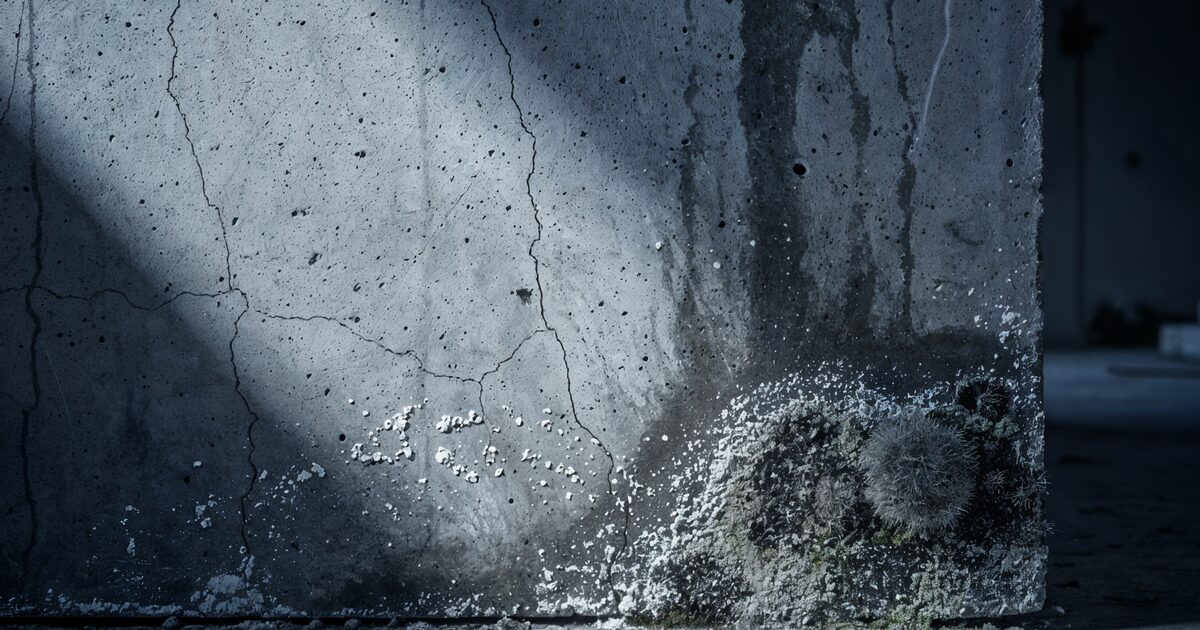
Ground moisture drawn up into the structure by capillary action. Much of North Cyprus sits on clay-rich soils that hold water for long periods and stay saturated through the wet season, pressing moisture against foundations and ground-floor walls. It shows as a horizontal tide mark roughly 50 to 150 cm above floor level, white salt deposits and plaster crumbling at low level. Its defining feature is that it ignores the weather: a wall that is damp in a dry week in July, with no plumbing nearby, is the classic case.
Why closed-up properties suffer worst
A large share of the homes we work on are used for part of the year. The owners are in the UK from November to April, the shutters are down, the doors are locked and nothing moves for months. That combination is exactly what mould needs.
With the property closed, the indoor air is still, the surfaces are at their coldest of the year, and any moisture in the structure has no way of drying out. Furniture pressed against external walls creates pockets where the air never moves at all. There is no one there to notice a ceiling stain in week two, so by the time you come back in April a small roof defect has had an entire wet season to work on the plaster.
If you leave the property empty over winter
- Pull furniture 5 to 10 cm off external walls so air can move behind it, especially wardrobes and sofa backs
- Leave internal doors open so the whole property shares the same air, rather than sealing cold rooms off
- Leave a trickle of ventilation rather than sealing the property completely airtight
- Leave nothing damp behind: no laundry or bedding, and leave the washing machine door and shower screen open
- Ask whoever holds your keys to check the ceilings after the first serious rain of the season
- Have the roof outlets cleared before the wet season starts, not after
One visit in December is worth a lot
The single most useful thing an absent owner can arrange is for someone to walk through the property after the first heavy rain of the winter and photograph any ceiling or wall staining. A roof defect caught in December is a repair. The same defect found in April has had three months of water going into the slab.
Working out which one you have
You can get a long way before anyone comes out, with two cheap tests and a bit of observation.
Three checks you can do yourself
The foil test
Tape a piece of aluminium foil around 30 x 30 cm flat to the damp area, sealing all four edges with tape so no air gets behind it. Leave it for 48 hours, then lift it. Wet on the room side means the moisture is coming out of the air and you have condensation. Wet on the wall side means moisture is coming through the wall, so you are looking at penetrating or rising damp. Wet on both sides means both are happening and you need a proper survey.
Measure the humidity
Put an inexpensive digital hygrometer in the affected room and check it over a week. You want 40 to 55 per cent in winter and 40 to 50 per cent in summer. Between 55 and 65 per cent is worth watching. Between 65 and 75 per cent condensation is likely and something needs to change. Held above 75 per cent, mould will follow.
Track it against the weather
Note when the patch is at its worst. Only after rain points to penetrating damp. Constant year-round with no reaction to rain points to rising damp or ground water pressure. Worse in winter, better in summer, worst in the mornings points to condensation. This single observation rules out more wrong answers than any instrument.
Read the salts
White, powdery deposits are efflorescence: the mineral salts left behind when water evaporates out of masonry. They tell you water has been travelling through that wall for a sustained period rather than once, and that cleaning the surface will achieve nothing, because they will return as long as the water path is open.
Do not assume it is the roof
Ceiling stains are not always roof failures, and this is worth saying plainly before anyone spends money. A stain under a bathroom, a kitchen or a rooftop water tank is often a plumbing leak. A stain against the wall of the balcony above is usually the balcony, not the roof. When we survey, working out whether we are looking at a building fault or a plumbing fault is the first question we answer, because the two lead to completely different jobs.
What actually fixes it
Each mechanism has its own fix, and they are not interchangeable.
Condensation: make the surfaces warmer
Ventilation helps, but it manages the problem rather than curing it. The fix is raising the temperature of the cold surfaces so the moisture in the air has nowhere to condense, which means insulation, applied in this climate to the outside of the wall as an external wall insulation system. It removes the cold bridging at the concrete frame that ventilation cannot touch, and in summer it works in the opposite direction and cuts the heat load coming in. Our facades and rendering work covers this.
Alongside that: extract properly from the bathroom and kitchen, dry washing outside rather than on an airer indoors, keep furniture off external walls, and ventilate briefly but properly rather than leaving one window on the latch all day.
Penetrating damp: repair the thing that is letting water in
There is no treatment you can apply to the inside of a wall that will hold back water arriving from outside. The repair has to be made where the water gets in.
On a roof or terrace that means stripping back the failed covering, correcting the falls to a minimum of 1.5 to 2 per cent towards the outlets, priming, and laying a properly lapped membrane system with the upstands and detailing done correctly. On a balcony it means taking up the tiling, re-forming the falls, tanking and re-tiling. On a facade it means cutting out and repairing the cracked render and recoating with a UV-stable, water-repellent exterior system rather than a cheap emulsion that will craze again in two summers. This is the core of our waterproofing work.
Rising damp and ground water: cut the path
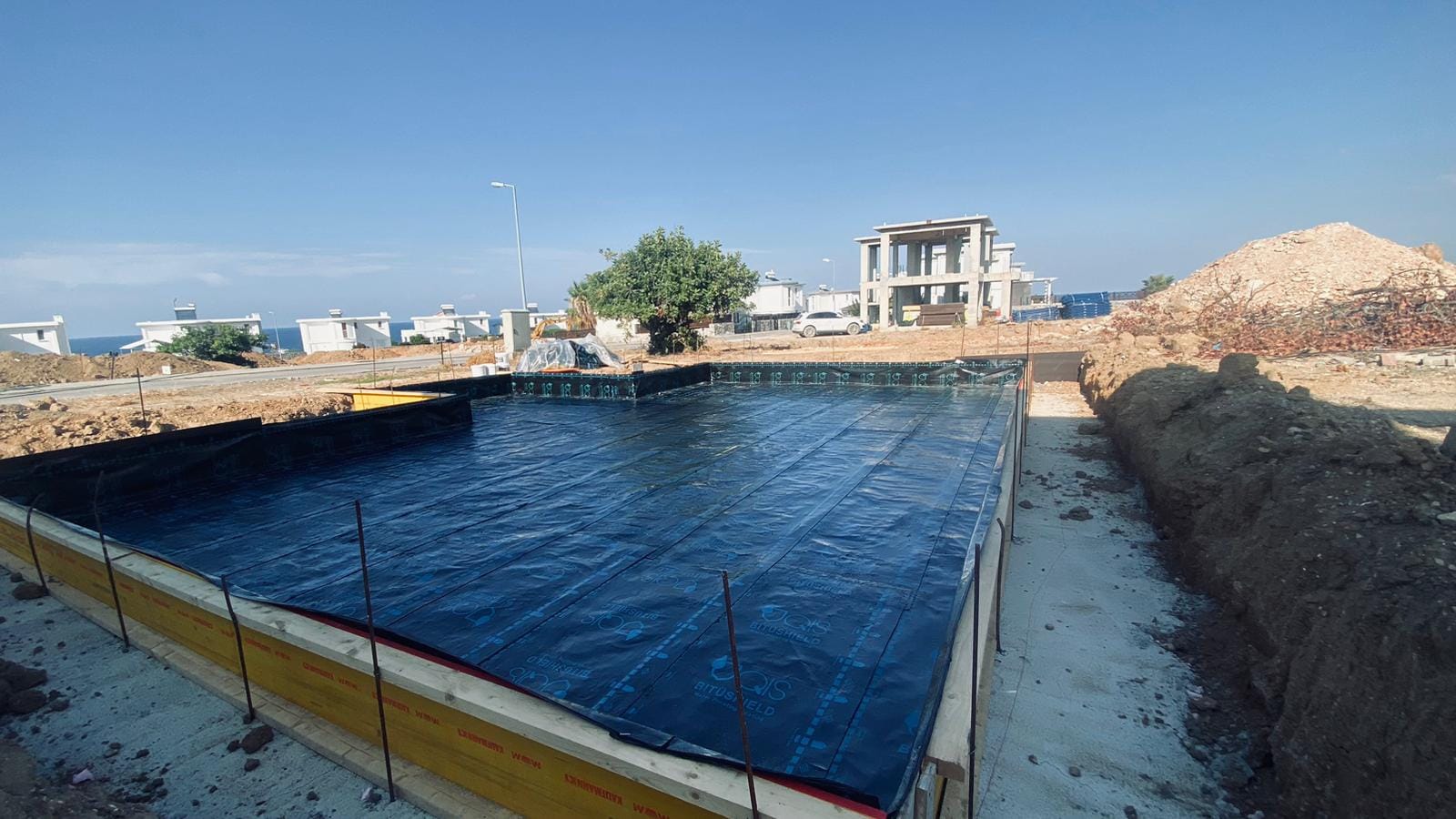
Where moisture is coming out of the ground, the effective repair is external: excavating to expose the foundation or retaining wall, cleaning it back, priming, applying membrane, then adding a drainage layer and geotextile before backfilling. That cuts the water off at source.
Where excavation is impossible, the alternative is working from the inside with a cementitious tanking system applied to the internal face. It is less effective than dealing with it externally, but it is a legitimate approach and often the only practical one in an apartment or a terraced property.
What does not work
Money we regularly see wasted
- Repainting over a damp patch. Paint over damp plaster typically blisters again within three to six months, and each cycle takes more plaster with it.
- Anti-mould paint on a wall that is wet from behind. It is a surface product for a surface problem.
- Running a dehumidifier as the permanent answer to a leak. It removes water that keeps being replaced, forever, at your cost.
- Sealing the outside of a wall with an impermeable coating so it cannot dry. Trapped moisture pushes the coating straight back off.
- Patching one crack on a roof whose membrane has reached the end of its life across the whole area. You will be back up there next winter.
- Tiling straight over a leaking balcony or wet room without tanking underneath. The tiles are not the waterproofing layer, and the grout certainly is not.
When to get someone in
Some damp is manageable with ventilation and a bit of habit change. The following are not, and are worth acting on before the wet season:
- A damp patch or mould that has come back within three to six months of being redecorated.
- Active dripping, or a stain that visibly grows during rain.
- Salt deposits, blown plaster or crumbling render at low level on a ground-floor wall.
- Damp appearing in more than one room at the same time, which usually means a shared cause rather than a local one.
- A property over twenty years old with no known waterproofing history, particularly if it has never had the roof looked at.
- A newer property already showing ceiling stains, which usually points to detailing that was rushed at construction rather than anything wearing out.
The right time to deal with any of it is now rather than in December. Surfaces have to be genuinely dry before waterproofing can go down, so work booked once the rains have started often waits for a dry spell. The practical working seasons here are roughly March to May and September to November.
We have been working on buildings in North Cyprus since 1999, from a base on Ankara Caddesi in Alsancak, just outside Kyrenia. We survey free of charge, tell you which of the three mechanisms you are actually dealing with, and put the scope and price in writing before anything starts. Everything is handled in English, including while you are back in the UK, and our waterproofing installations carry a 5-year workmanship guarantee. Call +90 533 831 14 32 or email [email protected].
See our recent projects across the Kyrenia region, or our renovation and refurbishment work for putting the affected rooms back afterwards.