The first leak is rarely the first problem
The call usually comes in December or January. There has been a night of heavy rain, and by the morning there is a brown ring on a bedroom ceiling that was not there the day before. Sometimes there is water actually dripping.
What has happened is not that the roof failed that night. The roof failed some time over the previous summer, when months of heat and UV worked the membrane past the point where it could still move without splitting. The rain simply found it. That gap between the failure and the symptom is why flat roofs here are so often dealt with too late, and why the repair usually has to be more extensive than the owner was expecting.
The other thing that surprises people, particularly British owners who have bought on a newer development, is how young the roof can be. A five- or six-year-old villa leaking at the parapet is not unusual here at all.
Why flat roofs here fail early
Almost every building in North Cyprus has a flat concrete roof or a roof terrace. It is the local architecture, and it is not a bad way to build. It is just far less forgiving than a pitched roof, because a pitched roof works by geometry whether or not anyone thought about the detailing, and a flat roof only works if someone did.
The UV load is brutal
The UV index here reaches 11 in July, and is still at 9 through April and May, roughly two to three times what Central Europe sees. UV breaks down the molecular structure of membrane materials. The membrane hardens, loses its elasticity, and cracks. A bituminous membrane left fully exposed with no protective layer loses meaningful performance in 8 to 12 years here, against 20 to 25 years for the same product in northern Europe.
The daily temperature swing works everything loose
Summer air temperatures run at 33 to 37°C, but a dark roof surface in direct sun reaches 70 to 80°C, then drops back to 20 to 25°C overnight. That is a swing of 50 to 60 degrees, every day, all summer. Concrete and membrane expand and contract at different rates, and after a few hundred cycles the difference shows up as micro-cracking, concentrated at exactly the points that matter: parapet junctions, pipe penetrations and movement joints.
The rain is concentrated
Annual rainfall is about 500 mm, of which roughly 60 per cent falls between December and February. So the membrane spends half the year being baked and then gets tested by intense rain arriving in short bursts. Where the falls are inadequate, water stands on the roof and applies constant pressure to a covering that is already tired.
Sea salt on the coast
On the coastal strip through Kyrenia, Alsancak, Çatalköy and out towards Esentepe, airborne salt settles on the roof surface. It accelerates corrosion of metal components such as outlet gratings, trims and fixings, and works into the surface of the concrete. Coastal roofs age faster than roofs a few kilometres inland.
And then there is how it was built
The climate explains why roofs here need to be good. It does not explain why so many new ones fail. That comes down to a set of shortcuts we see repeatedly: a single membrane layer where two are needed, falls that were never properly formed, laps below the minimum 10 cm, primer skipped, and details around outlets and parapets finished in a hurry at the end of the job.
Dark roofs cook their own covering
An unprotected dark roof surface reaching 70 to 80°C in summer will roughly halve the working life of a standard membrane. A light-coloured or reflective coating brings the surface temperature down by 20 to 30°C, lowers the temperature inside the rooms below by 3 to 5°C, and can be applied to an existing sound roof as a retrofit.
Is it the roof, or is it plumbing?
This is the first question worth answering, because getting it wrong is expensive. A ceiling stain is evidence of water, not evidence of a roof failure.
Reading the symptoms before anyone opens anything up
| What you observe | Points to the roof or terrace | Points to plumbing |
|---|---|---|
| Timing | Appears or grows 24 to 48 hours after heavy rain, then dries | Constant, or unrelated to the weather |
| Location | Under an open roof, terrace or the balcony above | Under a bathroom, kitchen, water tank or a pipe run |
| Shape | Diffuse patch, often near a wall junction or a downpipe | Tight, well-defined patch that keeps re-wetting the same spot |
| Season | Winter only | Any time of year, often worse when the property is occupied |
| Water meter | No change | Meter creeping up with everything turned off |
| What it means for the job | Waterproofing repair, usually at roof level | Trace and repair the pipe, then make good |
A quick check anyone can do: turn off every tap and appliance in the property and read the water meter, then read it again a couple of hours later. If it has moved, you have a plumbing leak somewhere, whatever the ceiling looks like. If it has not moved and the stain reacts to rain, you are looking at the roof.
Two further complications worth knowing about. First, water travels. It enters at one point, runs along the top of the slab or along a beam, and appears somewhere else entirely, which is why chasing the stain upward rarely lands on the actual defect. Second, on an apartment the water is often not coming through the roof at all but off the balcony or terrace of the flat above, which is a different repair and, under the condominium rules here, generally a different person's responsibility.
Where roofs actually let go
After twenty-five years of opening roofs up, the causes come down to a short list.
Detailing, not the open field
The large flat area of a roof is the easy part. Most leaks start at the details: parapet junctions, chimney and vent surrounds, outlet mouths and movement joints. These are the points that move most, and they are the points that need the most careful work. A membrane that stops short at the parapet instead of being dressed at least 20 cm up the upstand is one of the most common faults we find.
Falls and standing water
A flat roof needs a minimum fall of 1.5 to 2 per cent towards the outlets. Plenty of roofs here were never given one, or had one that has been flattened by settlement. Water standing for more than 48 hours after rain is not a cosmetic issue: it loads the membrane continuously and shortens its life dramatically. No membrane, at any price, solves a falls problem.
Age and UV
Fifteen to twenty years is a realistic life here for a correctly installed system, less if it has been left fully exposed. Cracking starts invisibly and announces itself in the first serious rain after it has gone too far.
Mechanical damage
Air conditioning units, satellite dishes, solar panels and water tanks all get added after the waterproofing was finished, and every fixing is a penetration. Bolted straight through without a sealed detail, they become one of the most common leak points on an otherwise healthy roof.
Workmanship
Single-layer coverings where two are needed, laps under 10 cm, primer skipped so the membrane never bonded, seams not pressed out, application in the wrong conditions. A roof leaking within a couple of years of being laid is almost always one of these rather than a materials failure.
What a proper repair involves
This is the sequence we work to on a full roof re-covering. It is worth reading even if you are getting quotes elsewhere, because it gives you something concrete to ask about.
Flat roof re-waterproofing, step by step
Survey and strip out
The existing build-up is assessed, including what is underneath. Membrane that has blistered, lost adhesion or trapped moisture beneath it is stripped off rather than covered over. The deck is cleaned back and all debris removed. Anything wet left in the build-up will find its way through the new layer.
Correct the falls
Where water has been standing, screed is laid to give a minimum fall of 1.5 to 2 per cent to the outlets. The screed should be at least C20/25 and a minimum of 3 cm thick. In the dry air here it can cure too quickly, so it is kept damp while it sets, otherwise it cracks and you have built a new problem into the roof.
Prime the surface
A bitumen-based cold primer is applied over the whole deck with a brush or roller. It seals the pores of the concrete so the membrane bonds properly. Drying time is typically 4 to 6 hours, shorter in high summer. Skipping the primer is one of the reasons membranes lift.
First membrane layer, 3 mm
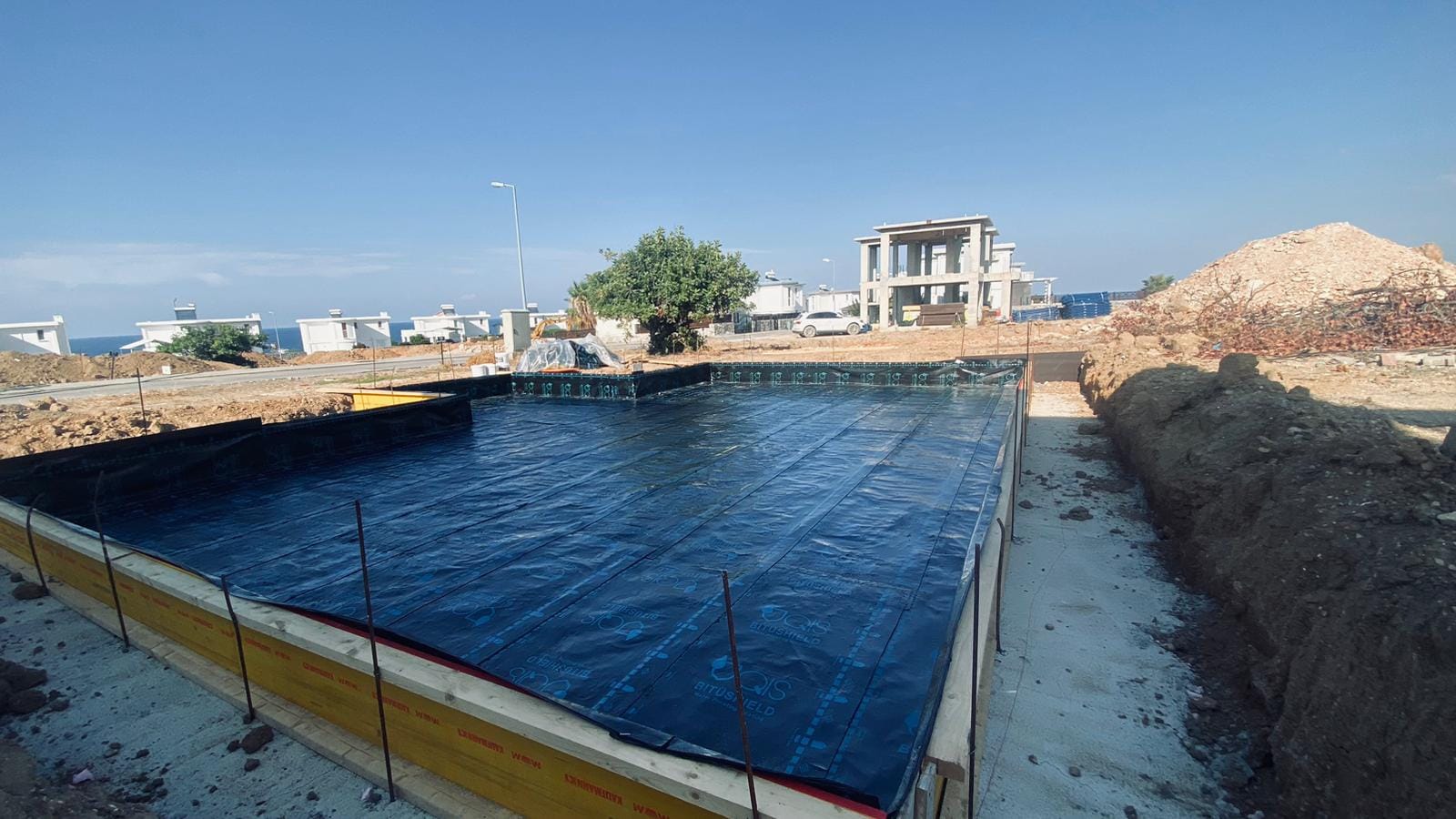
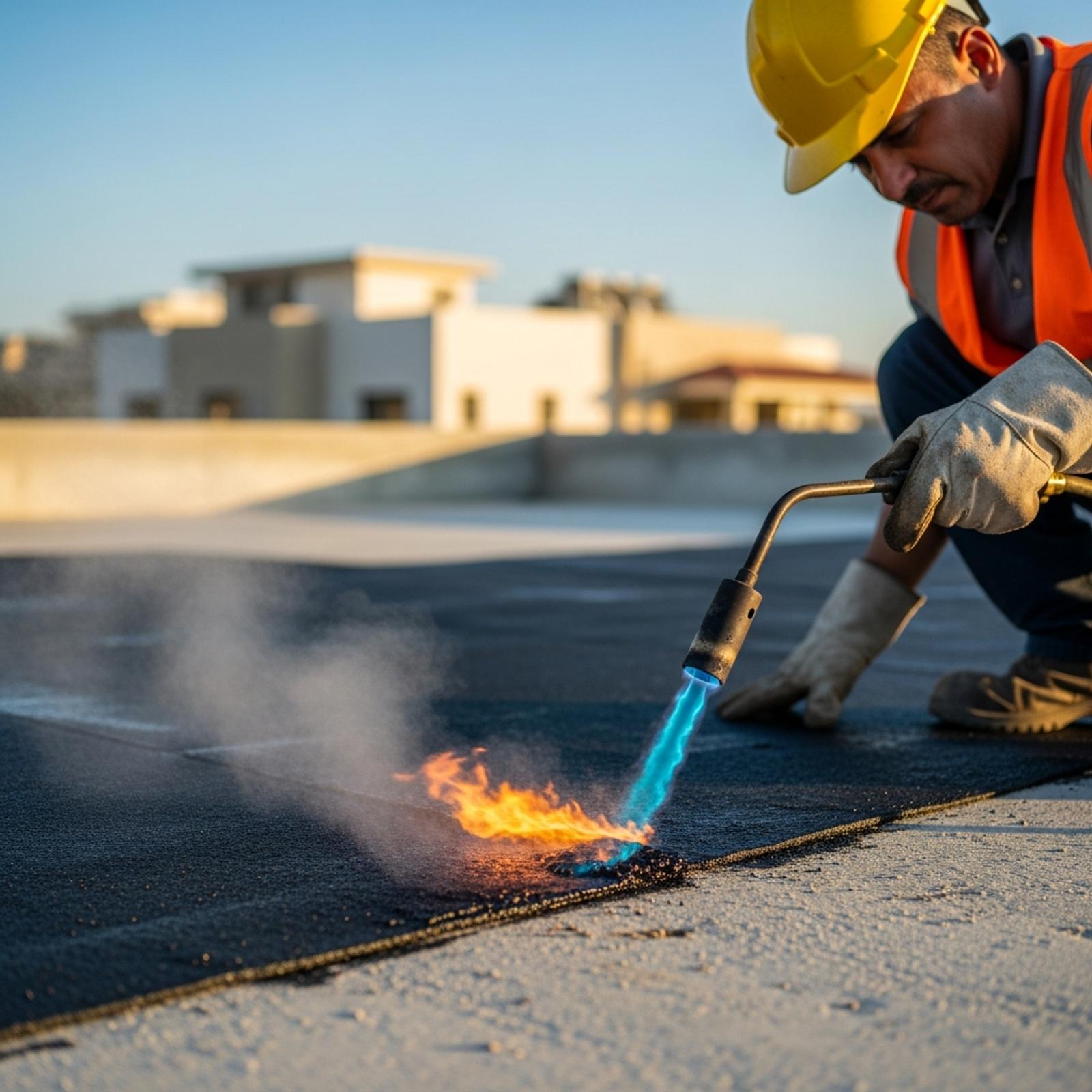
A 3 mm polymer-modified bituminous membrane is torched down to the primed deck. Every seam gets a minimum 10 cm overlap, and the seams are pressed out with a trowel so the bond is continuous rather than tacked at the edges.
Second membrane layer, 4 mm
A 4 mm layer goes over the first with the joints offset by at least 50 cm, so no seam in the top layer sits over a seam in the layer below. At parapets and upstands the membrane is dressed a minimum of 20 cm up the vertical face and terminated properly.
Detail the weak points
Outlets, pipe penetrations, vent surrounds and parapet corners are reinforced with liquid membrane or additional membrane collars. This is the slowest part of the job and the part most often skipped. It is also where most roofs leak, so it is not a place to save time.
Water test, then protect
Seams are checked, and where the construction allows the roof is flooded for 24 to 48 hours to prove it is watertight. Only once it has passed does the protective layer go on: a screed or tiled finish where the terrace is walked on, insulation boards in an inverted build-up, or a UV-stable reflective coating where it is not.
Consider the inverted build-up on a terrace you use
In a conventional roof the membrane sits on top and takes the full force of the UV and the daily temperature swing. In an inverted roof the membrane goes down first and the insulation boards sit above it, shielding it. The membrane is then protected rather than exposed, and expected life goes from 15 to 20 years up to 25 to 30. It costs more at the outset and makes sense on a terrace you actually use, or where you want insulation and waterproofing solved in one operation.
Patch repair or re-cover the whole roof?
Not every roof needs stripping. The honest answer depends on what the membrane looks like across the whole area, not just at the leak.
A patch repair is reasonable where the covering is generally sound, the damage is localised and identifiable, such as a tear or a penetration made for an air conditioning unit, and there is no standing water. It buys time at modest cost.
A full re-cover is the right call where the membrane is cracking or blistering across the roof rather than in one spot, where water stands after rain because the falls are wrong, where the roof is at or beyond 15 years old, or where it has already been patched more than once. Repeated patching on a roof at the end of its life is money spent postponing the same job.
Signs the roof needs re-covering rather than patching
- Water still standing on the roof more than 48 hours after rain
- Membrane that is hard and brittle rather than flexible, with hairline cracking across the surface
- Blisters or areas that sound hollow underfoot, meaning the membrane has lost its bond
- Seams that have opened or lifted along their edges
- More than one leak point appearing in the same winter
- A roof that has already been patched twice or more
- Stone chippings or protective finish washed away, leaving membrane fully exposed to UV
When to do the work
Timing matters more here than in Britain, because the constraint is not cold, it is moisture and heat.
The deck has to be genuinely dry before anything goes down. After heavy rain that means waiting, and once the wet season is properly underway it can mean waiting a long time. Membrane should not be applied in rain, and not below 5°C. At the other end, roof surfaces reach 70 to 80°C by the middle of a July day, at which point the membrane bonds too fast to be laid neatly and the work suffers, so summer jobs are worked early in the day.
That leaves two comfortable windows: roughly March to May, and September to November, with the ambient temperature in the 5 to 35°C range that membrane systems want. Midsummer is workable with an early start. December to February is the season you are trying to be finished before.
The practical implication for anyone with a leak: deal with it now. A roof booked in July is a planned job. The same roof in January is an emergency, done in poor conditions, on a deck that is never quite dry.
Making it last
A roof here is not a fit-and-forget item. A small amount of attention adds years.
Flat roof maintenance in the North Cyprus climate
| Task | How often | Why it matters |
|---|---|---|
| Clear the outlets and check they run | Every 3 months | A blocked outlet turns the whole roof into a pond |
| Visual check for cracks, blisters and splits | Twice a year, spring and autumn | Caught early it is a small repair; caught late it is a re-cover |
| Check parapets, upstands and penetrations | Annually | These are the points thermal movement attacks first |
| Renew reflective coating | Every 3 to 5 years | It loses effectiveness with time, and it is what keeps the membrane cool |
| Professional inspection | Every 5 years | Finds what is developing under the surface before it appears on your ceiling |
| Membrane renewal | Every 15 to 20 years | Membrane has a finite life here; renewing on schedule is cheaper than reacting |
There is an energy argument as well as a leak argument. An uninsulated dark concrete roof passes a great deal of heat into the rooms below, and insulating the roof can cut heating and cooling costs by 15 to 35 per cent. If the covering is coming off anyway, that is the moment to decide whether insulation goes in at the same time, because doing it then costs a fraction of doing it later.
If your roof is leaking, or you want to know how much life is left in it before you commit to anything else, we will come and look. The survey is free, you get a written quotation setting out the system, the scope and the price, and the work carries a 5-year workmanship guarantee. We have been doing this from Alsancak, just outside Kyrenia, since 1999, in English throughout. Call +90 533 831 14 32 or email [email protected].
More on our waterproofing and damp proofing work, or look through recent projects. If the leak has damaged the rooms below, our renovation team puts them back afterwards, and our guide to damp and mould in North Cyprus homes covers the wall side of the same story.